

















Get In Touch
Contact Us Today for a
Comprehensive Analysis and Strategy Session.
Ready to level up your online game? Call (844) 200-6112 or dive into the form below.
Embrace the future of collaboration with OmniFunnel's Oculus 2 VR headset offer for valued clients. It's your entry into immersive VR meetings in the metaverse, redefining digital meetings and shaping virtual collaboration in the realm of web3.
In the digital advertising landscape, creative assets are the front line of your marketing campaigns. Yet most advertisers are flying blind, relying on gut instinct and limited A/B tests to determine which visuals will drive performance. The result? Wasted ad spend, creative fatigue, and missed opportunities to maximize return on ad spend. Traditional creative testing methods simply cannot keep pace with the demands of modern digital marketing, where audiences expect personalized, engaging content across multiple platforms simultaneously.
Artificial Intelligence is fundamentally transforming how brands approach creative testing. According to industry research from Celtra, AI-powered creative testing allows marketers to identify winning ad variants far faster than traditional methods. Instead of testing two versions over weeks, AI can handle multivariate experiments simultaneously, delivering actionable insights in hours rather than weeks. The impact is measurable: AI-optimized creatives can deliver up to two times higher click-through rates compared to manually designed versions, while AI tools now achieve over 90% accuracy in predicting creative success before launch—a massive improvement compared to the 52% accuracy of human judgment alone.
At OmniFunnel Marketing, we have leveraged AI-powered creative testing across thousands of campaigns, consistently outperforming industry benchmarks with conversion rates of 7% versus the 2.35% industry average. Our proprietary DeepML technology analyzes vast datasets to extract actionable insights about which creative elements resonate with specific audience segments, enabling us to optimize ad visuals at scale. This comprehensive guide reveals how you can harness AI-powered creative testing to transform your advertising performance, reduce costs per acquisition, and achieve sustainable competitive advantage in an increasingly crowded digital marketplace.

Creative testing is the systematic process of running structured experiments with different ad variations to determine what performs best with your target audience. Rather than relying on assumptions or design preferences, creative testing lets performance data guide your decisions about which visuals, messaging, colors, layouts, and calls-to-action drive the strongest results. Traditional creative testing typically involves A/B testing—comparing two versions of an ad to see which performs better on metrics like click-through rate, conversion rate, or cost per acquisition.
While A/B testing remains valuable, it has significant limitations when applied at scale. Testing two versions of an ad requires sufficient traffic and time to reach statistical significance, often taking weeks to produce actionable results. If you want to test multiple variables—such as headline, image, call-to-action button color, and background—the number of possible combinations explodes exponentially. Testing each combination individually would require months of time and enormous budgets to achieve meaningful results.
This is where AI revolutionizes the creative testing process. AI-powered platforms can conduct multivariate testing at scale, simultaneously evaluating dozens or even hundreds of creative variations across different audience segments. Machine learning algorithms analyze performance data in real-time, rapidly identifying patterns that indicate which creative elements drive engagement and conversions. According to research on machine learning optimization tools, these AI systems can identify patterns in campaign data and enable more informed decisions in real time, analyzing user behavior, creative performance, and contextual signals to support more effective targeting and delivery strategies.
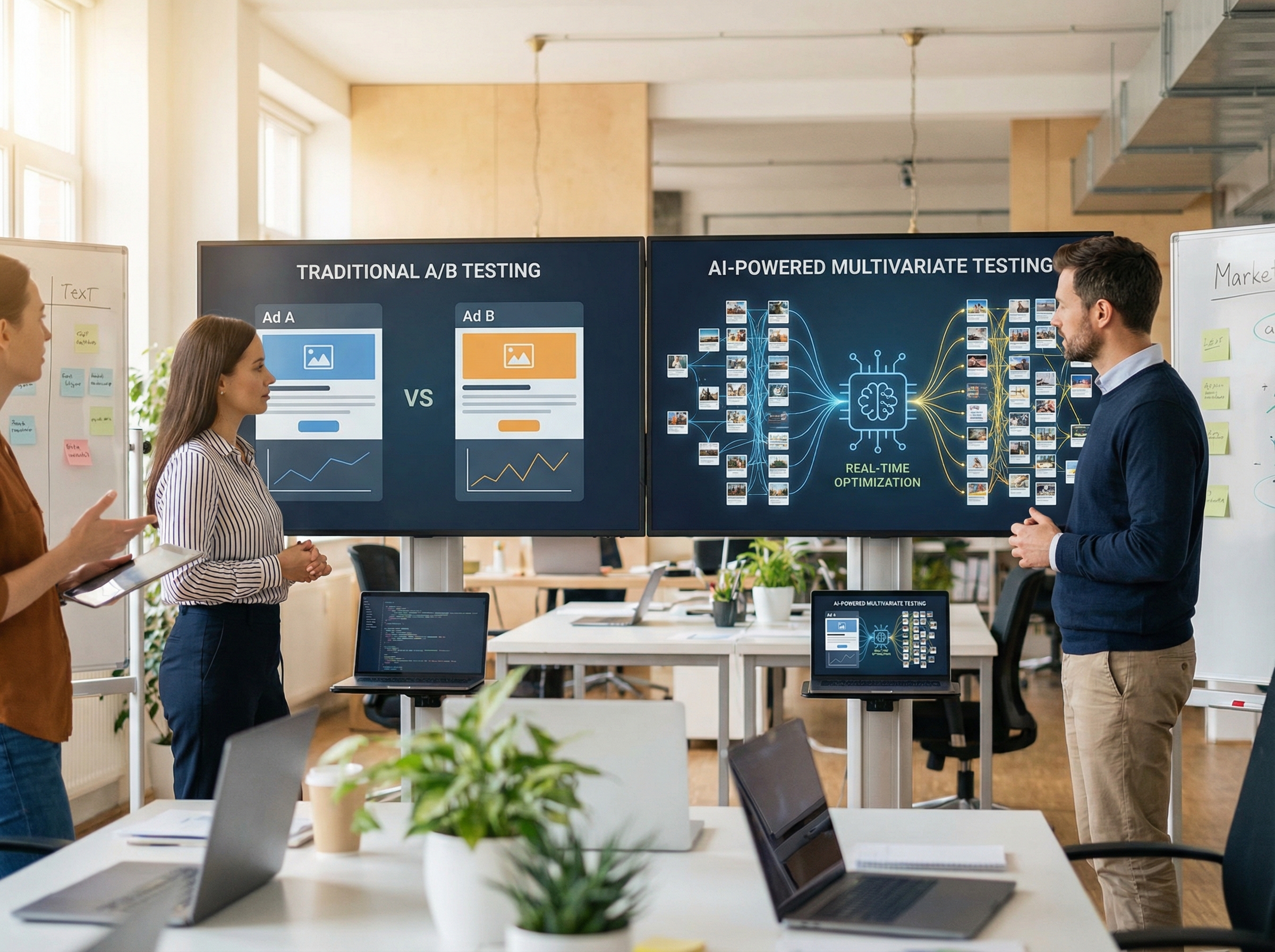
Modern AI creative testing platforms offer capabilities that were impossible just a few years ago. They can automatically generate creative variations by swapping out images, headlines, colors, and layouts based on predefined templates. They can predict which variations will perform best before you spend a dollar on media, using historical data and pattern recognition. They continuously optimize campaigns by automatically allocating more budget to winning variations and pausing underperformers. Most importantly, they learn from every impression and interaction, becoming more accurate over time as they accumulate more performance data across your campaigns.
The adoption of AI-powered creative testing is not just a trend—it represents a fundamental shift in how successful advertisers approach campaign optimization. The data supporting this shift is compelling. Companies actively using AI in marketing campaigns see between 20% and 30% higher ROI, with these gains coming from efficiency in creative generation and smarter targeting. For brands using AI-powered creative insights, the results are even more dramatic, with some reporting up to 40% increases in sales.
The performance advantages manifest across multiple key metrics. AI-driven ads report 41% higher conversion rates compared to traditional approaches, while companies like Google have documented 17% higher return on ad spend from AI-powered video campaigns compared to manual campaigns. The speed advantage is equally significant—brands can now validate creative concepts in hours and optimize campaigns continuously, whereas traditional creative testing used to take weeks and cost thousands of dollars.
At OmniFunnel Marketing, our results demonstrate the transformative potential of AI-powered creative testing. We have achieved 10X paid media revenue increases for clients by combining machine learning-enhanced targeting strategies with AI-optimized creative assets. Our average cost per acquisition of $38 significantly outperforms the $60 industry average, while our 5.25:1 return on ad spend exceeds the 2.87:1 industry benchmark. These results stem from our ability to test creative variations at scale, rapidly identify winning combinations, and continuously optimize based on real-time performance data.
The marketing landscape has reached a tipping point where AI adoption has evolved from experimental to essential. Nearly 90% of marketers now integrate AI into their processes in some form, with 47% specifically using AI for bid optimization and creative testing. Among advertisers planning for the future, 58% plan to increase AI usage for creative generation in the next year, recognizing that competitors who master AI-powered creative testing will hold significant advantages in efficiency, performance, and cost-effectiveness.
AI-powered creative testing platforms can evaluate virtually every element of your ad creative, but not all elements have equal impact on performance. Understanding which components to prioritize ensures you focus testing efforts on changes that will drive meaningful improvements in your advertising results. Modern optimization tools allow for comprehensive evaluation of what resonates with your audience, from macro-level concepts to micro-level details.
Visual assets—including images, videos, and graphics—typically have the greatest impact on ad performance. Your choice of imagery communicates your brand message instantly and determines whether users stop scrolling to engage with your ad. AI testing should evaluate different image styles (product-focused versus lifestyle imagery), subject matter (people versus objects), composition (close-ups versus wide shots), and visual tone (bright and energetic versus calm and professional). For video ads, test different opening hooks, video lengths, pacing, and whether to use sound-on or sound-off optimization. The goal is identifying which visual approaches resonate with specific audience segments while maintaining brand consistency.
Headlines and ad copy represent another critical testing dimension. Different audience segments respond to different messaging approaches—some prefer direct, benefit-focused headlines while others engage more with curiosity-driven or emotional appeals. AI can rapidly test variations in messaging tone, length, specificity, and value proposition emphasis. Test whether your audience responds better to questions versus statements, feature-focused versus benefit-focused copy, and urgency-driven versus value-driven messaging. The insights gained from headline testing often transfer across campaigns and channels, making this a high-value testing priority.
Color choices and design layout influence both attention and conversion. Color psychology research shows that red provokes strong emotions and symbolizes passion and energy, yellow signifies optimism and mental clarity, blue indicates serenity and helps build trust, while orange conveys excitement but also hints at caution. However, color effectiveness varies by industry, product category, and cultural context. AI testing removes the guesswork by showing which color schemes drive performance with your specific audience. Similarly, layout variations—including the placement of images, headlines, and calls-to-action—can significantly impact how users process your ad and whether they take desired actions.
Call-to-action buttons and formats deserve dedicated testing attention. The specific wording of your CTA button ("Shop Now" versus "Learn More" versus "Get Started"), button color, size, and placement all influence conversion rates. Test different CTA approaches based on where users are in the customer journey—awareness stage audiences may respond better to softer CTAs like "Learn More," while bottom-funnel audiences convert better with direct action-oriented CTAs like "Buy Now" or "Claim Offer." AI can identify these nuances across different audience segments, enabling personalized CTA strategies that maximize conversion rates.
Ad format and platform-specific optimizations represent an often-overlooked testing opportunity. What works on Facebook may not work on Instagram, TikTok, or LinkedIn. Short, attention-grabbing visuals succeed on social platforms with shorter attention spans, while longer, information-rich content performs better on professional platforms like LinkedIn. AI testing should evaluate how creative performs across different platforms, devices (mobile versus desktop), and placements (feed versus stories versus display network). This enables you to customize creative assets for each platform while maintaining consistent brand messaging across your omnichannel marketing strategy.
Successful AI-powered creative testing requires more than just technology—it demands a structured framework that aligns testing activities with business objectives, ensures statistical rigor, and enables continuous learning and optimization. A well-designed creative testing framework transforms random experimentation into a systematic process that consistently generates actionable insights and drives measurable performance improvements.
The foundation of your framework begins with clear key performance indicators tied directly to business goals. Every creative test should have a defined purpose aligned with metrics like click-through rate, cost per acquisition, return on ad spend, or conversion rate. Without clear KPIs, creative testing becomes unfocused activity rather than strategic optimization. Your framework should specify which metrics matter most for different campaign objectives—awareness campaigns prioritize reach and engagement metrics, while conversion campaigns focus on cost per acquisition and return on ad spend.
Implement a hypothesis-driven testing approach where each test begins with a specific prediction about what will improve performance and why. For example: "We hypothesize that lifestyle imagery showing our product in use will outperform product-only shots because our audience research indicates they value seeing real-world applications." This approach ensures tests are grounded in strategic thinking rather than random variation, and it builds organizational knowledge as you validate or disprove hypotheses over time. Document your hypotheses and results to create a knowledge base that informs future creative decisions.
Prioritize your testing roadmap based on potential impact and ease of implementation. Start with concept-level tests that evaluate fundamentally different creative approaches before optimizing details. Testing whether video outperforms static images matters more than testing which shade of blue works best for your CTA button. Once you have validated your core creative direction, move to optimization tests that refine specific elements. This staged approach prevents wasting resources on detail optimization of creative concepts that may not resonate with your audience in the first place.
Ensure adequate sample sizes to reach statistical confidence in your test results. AI can accelerate testing, but it cannot eliminate the need for sufficient data to draw reliable conclusions. Allocate enough budget per variant to reach statistical significance—aim for approximately 1,000 conversions or 10,000 impressions per variant for early directional insights. Avoid testing too many variants simultaneously, as this dilutes traffic and extends the time required to achieve significance. Industry best practices suggest testing 2-4 variants per test cycle for optimal results.
Transform your creative testing framework into a continuous learning system where insights from each test inform subsequent tests and broader creative strategy. AI platforms excel at identifying patterns across multiple tests, revealing which creative principles consistently drive performance with different audience segments. Regular review sessions should analyze testing results not just for immediate optimization decisions but for strategic insights that can guide creative briefs, agency partnerships, and brand guidelines. This systematic approach to learning from testing creates compounding returns as your organization's creative intelligence increases over time.
The AI creative testing technology landscape has exploded in recent years, with platforms offering varying capabilities, specializations, and pricing models. Selecting the right tools for your organization requires understanding the different categories of creative testing technology and how they integrate with your existing marketing stack. The right platform combination enables seamless testing workflows that fit naturally into your campaign management processes.
End-to-end creative testing platforms offer comprehensive solutions that handle both creative production and testing delivery. According to Celtra's complete guide to creative testing, true ad creative testing requires automation on both sides—production and delivery—and end-to-end platforms solve both challenges with integrated systems. These platforms typically provide template-based creative generation, automated variant creation, direct integration with major ad platforms, real-time performance tracking, and AI-powered optimization recommendations. They work particularly well for organizations running high-volume campaigns across multiple platforms who need streamlined workflows from creative concept to performance optimization.
Specialized multivariate testing platforms focus specifically on the testing and analysis component rather than creative production. These platforms excel at sophisticated testing methodologies, advanced statistical analysis, and detailed performance attribution. They integrate with your existing creative production tools and ad platforms to layer testing capabilities onto your current workflow. This approach offers flexibility for organizations with established creative processes who want to enhance testing rigor and analysis depth without completely overhauling their production workflows.
Major advertising platforms including Google, Meta, and TikTok have integrated AI-powered creative testing capabilities directly into their campaign management interfaces. Google Performance Max campaigns, for example, use AI to automatically test different creative combinations and optimize toward your conversion goals. These native tools offer the advantage of seamless integration and no additional platform costs, though they typically provide less flexibility and transparency than third-party specialized platforms. They work best for organizations running substantial campaigns on specific platforms who want to leverage that platform's first-party data and optimization capabilities.
At OmniFunnel Marketing, our proprietary DeepML technology represents the cutting edge of AI-powered creative optimization. DeepML combines advanced machine learning models with deep integration across multiple advertising platforms, enabling cross-platform learning that identifies which creative principles work across different channels and audience segments. This holistic approach to creative testing reveals insights that single-platform tools cannot detect, such as how creative that performs well on Meta might need specific adaptations to succeed on Google Display Network or how creative preferences vary across different stages of the customer journey.
When evaluating creative testing platforms, consider several key criteria. Integration capabilities determine how easily the platform connects with your existing ad accounts, analytics tools, and marketing technology stack. Testing methodology affects what types of tests you can run and how quickly you can achieve statistical significance. Reporting and visualization capabilities influence how easily your team can interpret results and extract actionable insights. Pricing models vary dramatically—some platforms charge based on ad spend managed, others on creative variations tested, and some use flat subscription fees. Finally, consider the learning curve and support resources available, as platform adoption requires training your team and establishing new workflows.
Implementing AI-powered creative testing successfully requires more than selecting the right platform—it demands careful planning, organizational alignment, and adherence to proven best practices that maximize your likelihood of success. Organizations that approach implementation strategically see results faster and avoid common pitfalls that derail creative testing initiatives.
Start simple and scale progressively rather than attempting to test everything at once. Begin with a single campaign or product line where you can dedicate sufficient budget and attention to learning the platform and refining your processes. Test one or two creative variables initially—such as image selection or headline approaches—before expanding to complex multivariate tests. This focused approach allows your team to build confidence and expertise while generating early wins that build organizational support for broader creative testing adoption.
Ensure your data foundation supports effective AI creative testing. AI algorithms require clean, consistent data to generate accurate insights. Implement proper tracking pixels, conversion tracking, and UTM parameters to ensure performance data flows accurately from ad platforms to your analytics systems. Verify that your attribution model appropriately credits creative variations with the conversions they influence. Poor data quality produces misleading test results that can lead to incorrect optimization decisions, undermining confidence in the entire creative testing program.
Align your creative production workflow with testing requirements. AI creative testing works best when you can rapidly generate creative variations to test. This may require establishing template-based design systems, creating modular creative assets that can be easily recombined, or partnering with agencies and freelancers who can deliver creative variations quickly. Consider building a creative asset library organized by element type (backgrounds, product images, lifestyle shots, headlines, CTAs) that enables rapid assembly of test variations. The faster you can produce creative variations, the more testing iterations you can complete and the faster you will identify winning approaches.
Foster cross-functional collaboration between creative teams, media buyers, and analytics professionals. Creative testing works best when creative teams understand what the data reveals about audience preferences, media buyers provide input on budget allocation and platform capabilities, and analysts ensure tests are properly designed and results are accurately interpreted. Regular review meetings where these stakeholders analyze test results together and plan subsequent tests ensure everyone understands the strategic rationale behind creative decisions and optimization priorities.
Establish documentation and knowledge management practices that capture insights from your creative testing program. Create a centralized repository that records test hypotheses, creative variations tested, performance results, and key learnings. This documentation serves multiple purposes: it prevents redundant testing of approaches you have already evaluated, it enables new team members to quickly understand what works with your audiences, and it provides evidence-based guidance for creative briefs and brand guidelines. Organizations that systematically document and share creative testing insights multiply the value of their testing investments across multiple campaigns and teams.
While core creative principles apply across advertising platforms, each channel has unique characteristics, audience expectations, and algorithm behaviors that require platform-specific optimization approaches. AI creative testing should account for these platform differences to maximize performance on each channel while maintaining consistent brand messaging across your integrated marketing campaigns.
For Meta advertising platforms including Facebook and Instagram, visual impact and immediate engagement drive performance. Users scroll rapidly through feeds, giving your creative just seconds to capture attention. Test bold, colorful visuals versus subtle, minimalist designs to determine what stops the scroll for your audience. Mobile optimization is critical, as the majority of Meta traffic comes from mobile devices—ensure text is readable on small screens and key visual elements are visible even in small formats. Video creative should be optimized for sound-off viewing with captions or text overlays that communicate your message visually. Test different video lengths, but recognize that shorter videos (15-30 seconds) typically outperform longer formats on Meta platforms.
Google Display Network and Performance Max campaigns require different creative approaches than social platforms. Display ads appear on third-party websites alongside content, competing with that content for attention. Test creative that clearly communicates your value proposition immediately, as users are typically focused on website content rather than actively browsing for products. Responsive display ads allow you to upload multiple headlines, descriptions, and images that Google's AI automatically combines and tests to find optimal combinations. Provide diverse asset options to give the algorithm maximum flexibility—upload images with different compositions, subjects, and color schemes along with headlines emphasizing different benefits and messaging approaches.
Search advertising creative requires emphasis on relevance and alignment with user intent. Users searching for specific keywords have clear intent, and your ad creative should immediately confirm that your offering matches what they are seeking. Test headline variations that incorporate the keywords users are searching for, as this relevance increases click-through rates. Use dynamic keyword insertion strategically to automatically customize ad copy based on the specific search query. For responsive search ads, provide headlines and descriptions that can work in various combinations, and let Google's AI test different combinations to identify which arrangements drive the best performance.
TikTok and other short-form video platforms demand fundamentally different creative approaches than traditional advertising channels. TikTok users expect authentic, entertaining content rather than polished advertising. Test user-generated content styles, influencer partnerships, and trending format adaptations that feel native to the platform rather than like traditional ads. Hook users in the first second with immediate action, bold statements, or visual surprises—TikTok creative that starts slowly will be scrolled past instantly. Test both horizontal and vertical video formats, though vertical typically performs better on mobile-first platforms. Embrace platform-specific features like effects, music, and interactive elements that encourage engagement and sharing.
LinkedIn requires professional, value-focused creative that respects the business context in which users engage with the platform. Test creative that emphasizes business outcomes, industry expertise, and professional development rather than entertainment or lifestyle appeals. Thought leadership content, data-driven insights, and case studies typically perform well. Use clear, professional imagery and straightforward copy that quickly communicates why your offering matters to business professionals. Test different targeting approaches combined with creative variations, as LinkedIn's professional targeting capabilities enable highly specific audience segments that may respond to tailored creative messaging.
Effective AI creative testing requires defining and tracking the right metrics to evaluate creative performance and guide optimization decisions. While platforms provide dozens of metrics, focusing on key performance indicators aligned with your business objectives ensures testing efforts translate into meaningful business results rather than vanity metrics that look impressive but do not drive revenue.
Engagement metrics including click-through rate, video view rate, and engagement rate indicate how effectively your creative captures attention and generates interest. Click-through rate measures the percentage of users who see your ad and click through to your website or landing page. Higher CTR indicates your creative successfully motivates users to learn more about your offering. For video ads, view rate and average watch time reveal whether your creative holds attention—high view rates indicate engaging content that users watch rather than skipping. Engagement rate on social platforms measures likes, comments, shares, and other interactions that indicate your creative resonates with your audience.
Conversion metrics including conversion rate, cost per acquisition, and return on ad spend ultimately determine creative success. Conversion rate measures the percentage of users who click your ad and complete desired actions—purchases, form submissions, downloads, or other goal completions. This metric reveals how effectively your creative attracts qualified, high-intent users versus curiosity clicks that do not convert. Cost per acquisition shows how much you spend to generate each conversion, directly indicating creative efficiency—better creative lowers CPA by attracting more qualified users and improving conversion rates. Return on ad spend measures revenue generated per dollar spent on advertising, accounting for both acquisition cost and customer value.
Creative-specific metrics help diagnose which elements of your creative drive performance. A/B testing platforms typically provide metrics showing performance by creative variant, enabling you to identify which specific headlines, images, or layouts perform best. Heatmap analysis and attention prediction tools show which parts of your creative attract visual attention, revealing whether users notice your key value propositions and calls-to-action. Creative fatigue metrics track how performance degrades over time as audiences see the same creative repeatedly, signaling when you need to refresh creative assets to maintain performance.
Incrementality measurement determines whether your creative testing actually drives new results rather than simply capturing demand that would have converted anyway. Holdout tests where you measure conversions among a control group not exposed to your ads compared to the exposed group reveal true incremental impact. Brand lift studies measure changes in brand awareness, consideration, or purchase intent attributable to your creative campaigns. These incrementality metrics ensure your creative testing optimization delivers real business value rather than optimizing for metrics that do not translate to incremental revenue.
Cross-platform attribution becomes critical when running creative tests across multiple advertising channels simultaneously. Users typically interact with multiple touchpoints before converting, and proper attribution ensures you credit creative variations appropriately for the conversions they influence. Multi-touch attribution models distribute credit across the various ads and channels users engage with during their path to purchase, providing more accurate insights into which creative approaches contribute to conversions compared to last-click attribution that credits only the final touchpoint.
Even well-planned AI creative testing initiatives can fail to deliver expected results when organizations fall into common traps that undermine testing validity, waste budgets, or produce misleading conclusions. Understanding and avoiding these pitfalls significantly increases your likelihood of creative testing success and ensures your optimization efforts drive genuine performance improvements.
Testing with insufficient sample sizes represents one of the most common and costly mistakes. Declaring winners before reaching statistical significance leads to false conclusions and suboptimal creative decisions. AI platforms can identify directional trends quickly, but directional trends are not the same as statistically significant results. Resist the temptation to end tests early even when preliminary results look promising. Establish minimum sample size requirements based on your baseline conversion rates and acceptable confidence levels, and commit to running tests until those thresholds are met. While this requires patience and budget discipline, it ensures your creative optimization decisions are based on reliable data rather than statistical noise.
Testing too many variables simultaneously creates confusion about what actually drives performance differences. When you test ads that vary in image, headline, color scheme, and layout all at once, you cannot determine which element caused performance differences. While AI multivariate testing can handle multiple variables, best practice involves controlling or limiting variation to enable clear attribution of results. Test major conceptual differences first (image style, messaging approach), then conduct subsequent tests that isolate specific elements once you have validated your core creative direction.
Ignoring creative fatigue undermines long-term campaign performance even when initial creative testing identifies winning variations. All creative assets eventually saturate their audience and experience declining performance as users see the same ads repeatedly. Monitor frequency metrics and performance trends over time to identify when creative refresh is needed. Build creative testing into an ongoing program rather than a one-time optimization project. Continuously develop and test new creative variations to replace fatiguing assets before performance significantly declines. This proactive approach maintains consistent campaign performance rather than experiencing boom-and-bust cycles as winning creative fatigues and performance drops.
Failing to account for platform algorithm learning periods causes premature optimization decisions. When you launch new creative variations, advertising platform algorithms require time to optimize delivery and identify the most responsive audience segments. Making changes during this learning period—typically 3-7 days depending on the platform—resets the learning process and delays optimization. Establish waiting periods before evaluating creative performance to ensure algorithms have sufficiently optimized delivery. This patience allows AI systems to work effectively rather than constantly resetting as you make premature changes based on incomplete learning.
Optimizing creative performance without considering brand consistency creates short-term gains at the expense of long-term brand equity. Creative that performs well in driving immediate clicks may not align with brand guidelines, positioning, or long-term messaging strategy. Establish creative guardrails that define acceptable ranges for testing while maintaining brand integrity. Review winning creative variations not just for performance metrics but for brand alignment, ensuring optimization decisions strengthen rather than dilute your brand over time. This balanced approach delivers sustainable performance improvements that compound over multiple campaigns rather than short-term wins that eventually undermine brand value.
The AI creative testing landscape continues to evolve rapidly as new technologies emerge and existing capabilities mature. Understanding emerging trends enables you to anticipate future opportunities and position your organization to leverage new capabilities as they become available. The convergence of several technological advances promises to make creative testing even more powerful, accessible, and integrated into marketing workflows.
Generative AI represents the most transformative trend in creative testing and production. AI content creation tools can now generate complete ad creatives—images, video, and copy—based on text prompts describing desired outputs. This capability dramatically accelerates creative production, enabling rapid generation of test variations without requiring designer or copywriter bandwidth for every iteration. Nearly 90% of advertisers plan to use generative AI in their video ad strategies, with AI-generated video potentially accounting for 40% of all ads by 2026. As generative AI quality improves and becomes more controllable, the bottleneck in creative testing shifts from production capacity to strategic direction and testing framework design.
Predictive creative scoring using AI to evaluate creative before launch represents another significant advancement. Rather than spending budget to test creative in-market, AI tools can now predict performance based on analysis of historical campaign data and creative characteristics. These tools achieve over 90% accuracy in predicting creative success, enabling you to filter out likely underperformers before they consume media budget. While in-market testing remains necessary to validate predictions and account for market changes, predictive scoring dramatically improves testing efficiency by focusing budgets on creative variations with the highest probability of success.
Cross-channel creative optimization that leverages learning from one platform to inform creative on other channels will become increasingly sophisticated. Current AI systems typically optimize within individual platforms, but emerging technologies aggregate learning across channels to identify creative principles that transcend specific platforms. This cross-channel intelligence enables you to develop creative strategies informed by insights from your entire advertising ecosystem rather than optimizing each channel in isolation. The result is more efficient testing programs that achieve insights faster and more cohesive brand experiences across all customer touchpoints.
Real-time creative personalization at scale represents the logical extension of current testing and optimization capabilities. Rather than testing a few creative variations and selecting winners, future systems will dynamically generate personalized creative for individual users based on their demographics, behaviors, and preferences. Early versions of this capability exist in dynamic product ads that show users products they have browsed, but emerging technologies extend personalization to all creative elements—imagery style, messaging tone, value proposition emphasis, and layout. This extreme personalization promises to dramatically improve relevance and performance, though it also raises privacy considerations and requires careful implementation to maintain brand consistency.
As AI creative testing becomes more powerful and prevalent, ethical considerations and governance frameworks will receive increasing attention. Over 70% of marketers have encountered AI-related incidents including bias, off-brand content, or inappropriate outputs, yet less than 35% plan to increase investment in AI governance. This gap between AI adoption and governance will narrow as industry standards emerge, regulatory frameworks develop, and organizations recognize that poor AI governance creates brand risks. Successful creative testing programs will incorporate review processes, bias detection, brand safety filters, and human oversight to ensure AI-optimized creative meets ethical standards and brand requirements.
AI-powered creative testing represents one of the highest-leverage opportunities in digital marketing today. The ability to systematically identify which creative approaches resonate with your specific audiences, optimize performance at scale, and continuously improve through data-driven learning creates sustainable competitive advantages that compound over time. Organizations that master AI creative testing consistently outperform competitors in cost efficiency, conversion rates, and return on ad spend—differences that translate directly to bottom-line business results.
Your journey toward AI-powered creative testing begins with honest assessment of your current capabilities. Evaluate your existing creative testing practices, technology stack, team capabilities, and organizational readiness. Identify gaps between your current state and the testing framework described in this guide. This assessment provides the foundation for a realistic implementation roadmap that accounts for your specific starting point and builds capabilities progressively rather than attempting wholesale transformation overnight.
Launch a focused pilot program that delivers quick wins while building organizational capabilities and confidence. Select a single campaign or product line with sufficient budget to support meaningful testing, clear success metrics, and stakeholder visibility. Implement basic A/B testing of major creative variables using either platform-native tools or a specialized testing platform. Document your process, results, and learnings meticulously. Share wins broadly to build organizational support for expanding creative testing to additional campaigns and more sophisticated testing methodologies.
Scale your creative testing program systematically by expanding to additional campaigns, incorporating more advanced testing methodologies, and deepening integration with your creative production and campaign management workflows. Invest in training for your team members, establishing standardized processes, and building the creative asset libraries and production capabilities that enable rapid test iteration. Transform creative testing from a specialized activity to a standard component of all paid advertising campaigns, embedded in planning processes and campaign briefs from the start.
For organizations seeking to accelerate their AI creative testing journey, partnering with experienced agencies like OmniFunnel Marketing provides immediate access to proven frameworks, proprietary technology, and expert teams who have optimized thousands of campaigns across dozens of industries. Our DeepML technology and full-funnel approach to creative testing deliver results that consistently outperform industry benchmarks—7% conversion rates versus 2.35% average, $38 cost per acquisition versus $60 average, and 5.25:1 return on ad spend versus 2.87:1 benchmark. We combine cutting-edge AI capabilities with strategic expertise to help you achieve transformational performance improvements while building internal capabilities that create lasting competitive advantages.
The digital advertising landscape will only become more competitive and complex in the years ahead. AI-powered creative testing provides the systematic, scalable approach you need to consistently identify what works, optimize performance, and stay ahead of competitors who still rely on intuition and limited testing. The question is not whether to adopt AI creative testing, but how quickly you can implement it and begin capturing the performance advantages it delivers. Start your journey today, and transform your advertising creative from a variable cost center into a predictable, optimized growth driver for your business.

As a beacon of innovation, we guide your business through the evolving digital landscape with cutting-edge solutions.

Our steadfast reliability anchors your strategic endeavors, ensuring consistent delivery and performance.

We harness state-of-the-art technology to provide smart, scalable solutions for your digital challenges.

Our extensive experience in the digital domain translates into a rich tapestry of success for your brand.

Upholding the highest standards of digital security, we protect your business interests with unwavering vigilance.

We offer a stable platform in the tumultuous digital market, ensuring your brand's enduring presence and growth.
OmniFunnel Marketing has garnered notable recognition from a range of prestigious media outlets. This acknowledgment from leading publications not only underscores our expertise in the digital marketing realm but also highlights our commitment to delivering exceptional marketing strategies. Our presence in these prominent media sources is a testament to the trust and value we bring to our clients, elevating their marketing efforts to new heights.





As a beacon of innovation, we guide your business through the evolving digital landscape with cutting-edge solutions.
Our steadfast reliability anchors your strategic endeavors, ensuring consistent delivery and performance.
We harness state-of-the-art technology to provide smart, scalable solutions for your digital challenges.
Our extensive experience in the digital domain translates into a rich tapestry of success for your brand.
Upholding the highest standards of digital security, we protect your business interests with unwavering vigilance.
We offer a stable platform in the tumultuous digital market, ensuring your brand's enduring presence and growth.

Experienced Senior Teams
Profit-First Strategy & Consulting
Channel-Specific Paid Media
Tracking & Attribution Specialists
Conversion Rate Optimization (CRO)
In-House Developers
In-House Creative Production
Proprietary First-Party Data Priming
Full-Funnel Feedback Loops
AI Voice Agents & Automated
AI Content Engine
MCP + LLM Real-Time Optimization
Value-Based Bidding & ROI
Installed CMO Leadership
You Own All Assets






Our talented team brings 20+ years of expertise and passion.

Michael Tate, CEO and Co-Founder of OmniFunnel Marketing, is a pioneering leader in leveraging AI and machine learning (ML) technologies to revolutionize digital marketing. With over 20 years of expertise in new media sales, Michael has distinguished himself as an SEO/SEM specialist, adept at integrating AI-driven strategies to enhance paid performance marketing. Since January 2016, he has been instrumental in transforming OmniFunnel Marketing into a hub of innovation, particularly in the legal and medical sectors. His philosophy, “more visibility without more expenditure,” is brought to life through AI-powered marketing tools, offering small and medium-sized firms a competitive edge.
His role involves not just client engagement but also orchestrating AI and ML tools to optimize marketing strategies for ROI maximization. Michael's expertise in AI-driven data analysis and workflow automation enables businesses to achieve unprecedented productivity and efficiency, ensuring robust online presence and profitability.
.webp)
Former foreign policy advisor turned digital marketing and communications consultant, Kalinda's extensive professional journey spans nearly two decades across both public and private sectors. Her expertise lies in strategic and creative marketing strategy, as well as communications management for businesses, associations, and government agencies. Having lived and worked globally, she has had the privilege of assisting businesses—both in the US and abroad—achieve their goals through impactful social media campaigns, community building, outreach, brand recognition, press relations, and corporate communication.
Kalinda's passion lies in cultivating meaningful relationships among stakeholders while building lasting digital brands. Her signature approach involves delving into each client’s unique needs and objectives from the outset, providing highly customized, bespoke service based on their needs. From political leaders to multi-unit restaurant concepts and multi-million dollar brands, Kalinda has successfully guided a diverse range of clients reach and exceed their digital marketing, public relations, and sales goals.

OmniFunnel Marketing's Director of Search Marketing, brings close to 15 years of digital marketing experience to leading the agency's paid media strategy. A dedicated Google Ads specialist at his core, Juan's command extends across Meta, TikTok, and Amazon, with a primary focus on ecommerce and an equally sharp discipline in lead generation. He has built and scaled campaigns across virtually every vertical, from local service businesses to national, multi-market accounts, and his leadership has been central to establishing paid media as one of OmniFunnel's most consistent growth engines.
What separates Juan's work is the conviction that campaigns are only as good as the signal beneath them. Before a dollar scales, he pressure tests the full measurement layer, tracking architecture, event design, and the quality of the conversion data flowing back to each platform, and he operates daily inside attribution platforms like Triple Whale and Northbeam, reconciling what Meta, Google, TikTok, and Amazon each claim against what the business actually banked. That foundation powers the fundamentals that move results: precise account structure, disciplined budget management, and relentless, data-driven testing and optimization, increasingly paired with AI-powered tools to sharpen targeting and surface insights faster. The combination lets OmniFunnel Marketing scale client accounts sustainably, growing spend and revenue in tandem while delivering measurable, lasting business growth.

Camila is a pioneering digital marketing leader who began shaping influencer strategy before it became an industry standard, partnering with mega brands like H&M, Universal Music, FabFitFun, FoxyBae, and Amika to name a few. An early adopter and entrepreneur, she evolved from affiliate manager to blogger to 7-figure ecommerce brand founder, and later accelerated growth for an innovative Silicon Valley software startup redefining personal health data ownership and user empowerment. Along the way, she played a pivotal role in educating leading global agencies, including Starcom, Ogilvy, and Universal McCann, on the power of influencer marketing in its formative years.
At OmniFunnel Marketing, Camila leads creative across every major social platform, Meta, Instagram, TikTok, YouTube, and beyond, carrying concepts from insight through finished production, often in front of the camera herself. She owns the full customer lifecycle as well, with expert command of email and SMS automation inside platforms like Klaviyo, building the flows, segmentation, and campaigns that turn first purchases into durable repeat revenue. With deep expertise in customer acquisition, scalable strategy, and trend forecasting, Camila bridges the gap between people and brands, aligning KPIs with market realities while delivering measurable growth. She remains at the forefront of digital innovation, integrating the power of AI with human insight to fuel growth, relevance, and long-term brand value.

Emma Harris, Chief Operating Officer (COO) of OmniFunnel Marketing, Emma plays a pivotal role in steering the operational direction and strategy of the agency. Her responsibilities are multi-faceted, encompassing various aspects of the agency's operations.
Emma utilizes her extensive operational experience to lead and oversee the agency's day-to-day operations. She is responsible for developing and implementing operational strategies that align with the agency's long-term goals and objectives. Her strategic mindset enables her to foresee market trends and adapt operational strategies accordingly, ensuring the agency remains agile and competitive.

Joseph Pagan, OmniFunnel Marketing's Director of Design & Development, is a visionary in integrating AI and ML into creative design and web development. His belief in the synergy of UI/UX, coding, and AI technologies has been pivotal in advancing OmniFunnel's design and development frontiers. Joseph has led his department in leveraging AI and workflow automation to create websites that are not only aesthetically pleasing but highly functional and intuitive
His approach involves using advanced AI tools to streamline web development processes, ensuring adherence to top-notch coding standards and design guidelines. This leads to enhanced efficiency, accuracy, and client satisfaction. Joseph's extensive experience across different design and development domains, combined with his proficiency in AI and ML, empowers OmniFunnel Marketing to deliver cutting-edge, user-centric digital solutions that drive business growth and customer engagement.

Sarah Martinez, as the Marketing Manager at OmniFunnel Marketing, holds a crucial role in shaping and executing the marketing strategies of the agency. Her responsibilities are diverse and impactful, directly influencing the brand's growth and presence in the market.
Sarah is responsible for crafting and overseeing the execution of marketing campaigns. This involves understanding the agency's objectives, identifying target audiences, and developing strategies that effectively communicate the brand's message. She ensures that each campaign is innovative, aligns with the agency's goals, and resonates with the intended audience.
Discover Success Stories from OmniFunnel's Diverse Portfolio.
Dive into the narratives of our clients who have embraced OmniFunnel's AI-driven marketing solutions to monumental success. Their experiences underscore our commitment to harnessing artificial intelligence for strategic marketing that not only reaches but resonates with target audiences, fostering robust engagement and exceptional growth.
Kevin Stranahan
Jane Martinez
David Butler
Discover Success Stories from OmniFunnel's Diverse Portfolio.
Dive into the narratives of our clients who have embraced OmniFunnel's AI-driven marketing solutions to monumental success. Their experiences underscore our commitment to harnessing artificial intelligence for strategic marketing that not only reaches but resonates with target audiences, fostering robust engagement and exceptional growth.
"OFM's expertise in eCommerce marketing is unparalleled. They optimized our PPC campaigns, revamping our ad spend to yield an astounding ROI. If you're looking to make waves in the digital world, look no further than OFM."
Kevin Stranahan
"Transparency and innovation are at the core of OFM’s services. Their monthly reports are comprehensive, and their readiness to adapt and innovate is remarkable. We've finally found a digital marketing agency we can trust for the long haul."
Jane Martinez
"OmniFunnel's AI solutions have exceeded our expectations and delivered outstanding results."
David Butler
Discover Success Stories from OmniFunnel's Diverse Portfolio.
Dive into the narratives of our clients who have embraced OmniFunnel's AI-driven marketing solutions to monumental success. Their experiences underscore our commitment to harnessing artificial intelligence for strategic marketing that not only reaches but resonates with target audiences, fostering robust engagement and exceptional growth.
"OFM's expertise in eCommerce marketing is unparalleled. They optimized our PPC campaigns, revamping our ad spend to yield an astounding ROI. If you're looking to make waves in the digital world, look no further than OFM."
Kevin Stranahan
"Transparency and innovation are at the core of OFM’s services. Their monthly reports are comprehensive, and their readiness to adapt and innovate is remarkable. We've finally found a digital marketing agency we can trust for the long haul."
Jane Martinez
"OmniFunnel's AI solutions have exceeded our expectations and delivered outstanding results."
David Butler
At OmniFunnel Marketing, we pride ourselves on being a beacon of innovation and excellence in the digital marketing world. As an award-winning agency, we are celebrated for our pioneering strategies and creative ingenuity across the digital landscape. Our expertise is not confined to a single aspect of digital marketing; rather, it encompasses a full spectrum of services, from SEO and PPC to social media and content marketing. Each campaign we undertake is an opportunity to demonstrate our skill in driving transformative results, making us a trusted partner for businesses seeking to navigate and excel in the complex digital arena. Our holistic approach ensures that every facet of digital marketing is leveraged to elevate your brand, engage your audience, and achieve outstanding growth and success


.webp)






Ready to level up your online game? Call (844) 200-6112 or dive into the form below.