

















Get In Touch
Contact Us Today for a
Comprehensive Analysis and Strategy Session.
Ready to level up your online game? Call (844) 200-6112 or dive into the form below.
Embrace the future of collaboration with OmniFunnel's Oculus 2 VR headset offer for valued clients. It's your entry into immersive VR meetings in the metaverse, redefining digital meetings and shaping virtual collaboration in the realm of web3.
The home services industry faces a defining challenge: 62% of companies cite landing new clients as their biggest operational headache. For HVAC technicians, plumbers, and electrical contractors, the gap between receiving a lead and converting it into a booked job represents thousands of dollars in lost revenue. Traditional marketing methods—phone tag, manual follow-ups, and scattered customer data—are no longer sufficient in a market where 56% of customers now search for service providers on mobile devices and expect instant responses.
Marketing automation has emerged as the solution that separates thriving home services businesses from struggling ones. According to industry research, companies implementing automation see an average return of $5.44 for every dollar spent, with most businesses recouping their investment in under six months. For home services contractors specifically, digital marketing automation delivers ROI ranging from 300% to 500% within the first year, with top performers achieving returns as high as 110X their initial investment.
The stakes are particularly high when you consider lead costs. In 2025, the average cost per lead for home services stands at $90.92, but this varies dramatically by specialty. Electricians face an average cost per click of $12.18, while roofing contractors pay $228.15 per lead on average. These numbers, compiled by LocaliQ's 2025 benchmarks, underscore why automated lead nurturing and conversion optimization are no longer optional—they're essential for profitability.
This playbook provides HVAC, plumbing, and electrical contractors with a comprehensive framework for implementing marketing automation systems that capture more leads, nurture them efficiently, and convert them at higher rates. You'll discover proven strategies for automating everything from initial lead response to customer retention, backed by real data and measurable results.
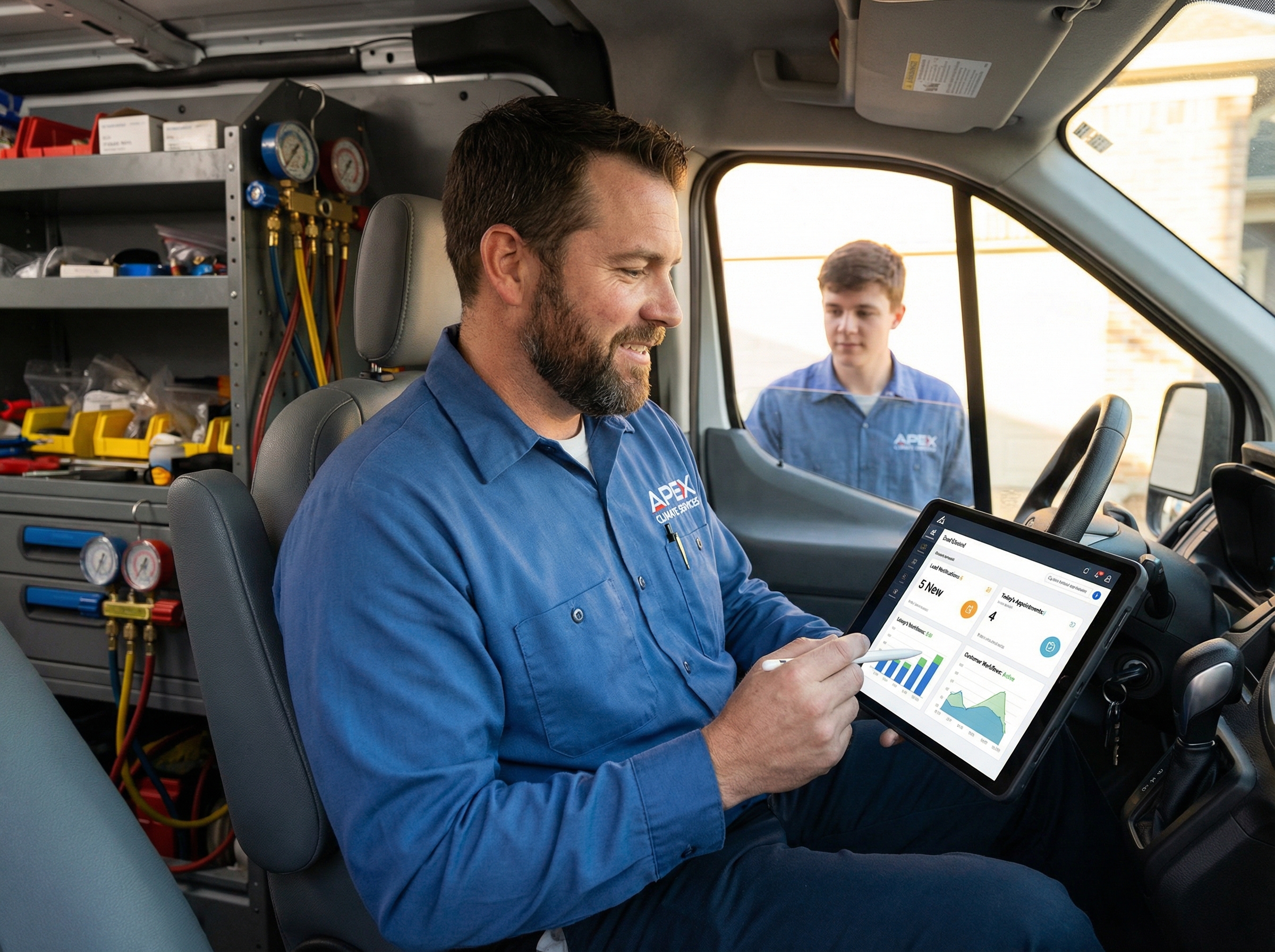
Marketing automation for home services refers to software platforms and workflows that handle repetitive marketing tasks automatically—without requiring manual intervention for each customer interaction. For contractors, this means your business continues generating, nurturing, and converting leads even when you're on a job site, after hours, or focused on delivering excellent service.
Effective marketing automation systems for home services include several interconnected components. Email automation sends targeted messages based on customer behavior and timeline triggers. SMS automation delivers instant confirmations, reminders, and follow-ups via text message. CRM integration centralizes customer data, service history, and communication records in one accessible location. Lead scoring automatically prioritizes high-value prospects based on their actions and profile. Finally, workflow automation creates seamless customer journeys from initial inquiry through completed service and beyond.
Today's customers expect instant responses and seamless interactions. Research from Plumbing & HVAC SEO shows that marketing automation can triple conversion rates for contractors by dramatically shortening the time from lead to booked job. When a homeowner submits an inquiry at 9 PM on Saturday, automated systems can acknowledge their request immediately, provide relevant information, and schedule follow-up—capturing opportunities that manual processes would miss until Monday morning.
The contrast between traditional and automated approaches is striking. Traditional marketing requires staff to manually respond to every inquiry, remember to follow up with estimates, track service reminders in spreadsheets or sticky notes, and hope customers remember to leave reviews. Automated marketing, by contrast, instantly acknowledges all inquiries with personalized messages, automatically follows up on estimates at optimal intervals, triggers maintenance reminders based on service history, and systematically requests reviews at the moment of peak customer satisfaction.
The efficiency gains translate directly to revenue. Automated email campaigns generate 320% more revenue than non-automated emails, with email marketing delivering an average ROI of $36 for every dollar spent. For home services contractors managing hundreds of customer relationships simultaneously, automation doesn't just save time—it makes previously impossible personalization scalable and profitable.
Marketing automation is only as effective as the lead generation strategies that supply it with prospects. For HVAC, plumbing, and electrical contractors, a multi-channel approach ensures a consistent flow of qualified leads entering your automated nurture sequences.
Local search engine optimization remains the most cost-effective lead generation channel for home services contractors. When someone searches "emergency plumber near me" or "HVAC repair in [city]," your business needs to appear in the local map pack and organic results. This visibility costs nothing per click and delivers highly qualified leads actively seeking your services.
Effective local SEO strategies begin with Google Business Profile optimization. Ensure your profile includes accurate business hours, service areas, high-quality photos of your team and completed work, and regular posts about seasonal services and promotions. Encourage satisfied customers to leave detailed reviews that mention specific services and locations. Each review strengthens your local search rankings and provides social proof that influences potential customers.
Your website should feature dedicated service pages for each specialty you offer—not generic "services" pages but specific content addressing "furnace repair in [city]," "water heater replacement," or "electrical panel upgrades." Include location-specific content that demonstrates your knowledge of local building codes, seasonal considerations, and community involvement. This localized content signals relevance to both search engines and potential customers.
Build consistent citations across local directories, industry-specific sites like HomeAdvisor and Angi, and local chamber of commerce listings. Ensure your business name, address, and phone number (NAP) are identical across all platforms. These citations reinforce your local presence and create additional pathways for customers to discover your services.
Paid search advertising provides immediate visibility and predictable lead flow. While organic SEO builds over time, Google Ads campaigns can generate qualified leads within hours of launch.
Google Local Services Ads deserve special attention for home services contractors. These "Google Guaranteed" ads appear at the very top of search results, above traditional Google Ads. They operate on a pay-per-lead model rather than pay-per-click, meaning you only pay when customers contact you directly through the ad. The Google Guaranteed badge builds immediate trust, and leads are typically high-intent homeowners with urgent needs.
Traditional Google Ads campaigns complement Local Services Ads by targeting broader search terms and offering more control over messaging and landing pages. Focus your campaigns on high-intent keywords that indicate immediate need: "emergency HVAC repair," "same-day plumbing service," or "licensed electrician near me." Use location extensions, call extensions, and promotion extensions to maximize ad real estate and provide multiple conversion paths.
Budget allocation should reflect lead value and competition in your market. With electricians paying an average of $12.18 per click and roofers facing costs above $10 per click, careful campaign management is essential. Implement conversion tracking to measure not just leads but booked jobs and revenue generated from each campaign. This data enables you to optimize bids, adjust budgets, and focus spending on the campaigns delivering the best return.
Social media serves dual purposes for home services contractors: building brand awareness and generating direct leads. Facebook and Instagram advertising enables precise targeting based on homeownership status, property type, household income, and geographic location—ideal parameters for reaching qualified prospects.
Facebook Lead Ads are particularly effective for home services. These ads allow users to submit contact information without leaving the Facebook platform, reducing friction and increasing conversion rates. Create campaigns promoting seasonal services—furnace tune-ups before winter, AC maintenance before summer, electrical safety inspections for older homes. Target homeowners within your service area who match your ideal customer profile.
Organic social media content builds the trust that converts leads into customers. Share before-and-after photos of completed projects, brief video tips on maintaining HVAC systems or preventing plumbing emergencies, customer testimonials and reviews, and team introductions that humanize your business. Consistent posting establishes your expertise and keeps your business top-of-mind when followers need services.
Respond promptly to comments and messages on social platforms. Many homeowners use Facebook Messenger or Instagram DMs to ask preliminary questions before submitting formal service requests. Quick, helpful responses build rapport and increase the likelihood these inquiries convert into booked appointments.
Referred customers are more valuable than leads from any other source. They convert at higher rates, have higher lifetime value, and require less convincing because they arrive with a trusted recommendation. Yet most contractors rely on passive word-of-mouth rather than systematic referral generation.
Automated referral programs make it easy for satisfied customers to recommend your services. After completing a job, automated emails can thank customers and include a unique referral link they can share with friends and neighbors. Offer incentives for both the referrer and the new customer—$50 off their next service for the referrer, $25 off for the new customer, for example. Track referrals automatically and ensure rewards are fulfilled promptly.
Strategic partnerships with complementary businesses create mutual referral networks. HVAC contractors can partner with home builders, real estate agents, and property managers. Plumbers benefit from relationships with home inspectors, kitchen remodelers, and appliance retailers. Electricians should connect with solar installers, home automation specialists, and general contractors. Formalize these partnerships with referral agreements and use your automation system to keep partners informed about mutual customers and referral status.
Most home services leads don't convert immediately. A homeowner researching HVAC replacement may spend weeks comparing options, gathering quotes, and timing their purchase. Without systematic nurturing, these leads go cold or choose competitors who stayed in touch. Automated nurture workflows ensure every lead receives consistent, valuable communication that moves them toward a purchase decision.
Speed to lead is the single most important factor in conversion rates. Studies consistently show that contacting leads within five minutes produces dramatically higher conversion rates than waiting even an hour. Yet most contractors can't guarantee five-minute response times manually—they're on job sites, driving between appointments, or simply managing multiple priorities.
Automated immediate response solves this challenge. When a lead submits a contact form, books a consultation through your website, or texts your business number, automation should trigger instantly. Send a text message confirming receipt: "Thanks for contacting [Company Name]! We received your request for [service type] and will call you within 30 minutes to discuss scheduling." Follow with an email providing additional information about your services, credentials, and what to expect.
Personalize these instant responses based on the service requested. A homeowner inquiring about emergency plumbing needs different messaging than someone requesting a routine maintenance quote. Segment your instant response templates by service category and urgency level to deliver relevant, helpful information that builds confidence while your team prepares for personal follow-up.
You've completed the on-site assessment, provided a detailed estimate, and the customer said they'd "think about it." What happens next often determines whether you win or lose the job. Competitors are following up, and homeowners juggling multiple estimates appreciate businesses that make it easy to say yes.
Automated estimate follow-up sequences keep your proposal top-of-mind without requiring manual effort. AI-powered workflows can schedule a series of touchpoints over two to three weeks: Day 1 sends the written estimate with a thank-you message. Day 3 shares a customer testimonial video showing a similar project. Day 7 provides answers to frequently asked questions about the proposed work. Day 10 offers to schedule a call to address any concerns. Day 14 introduces limited-time incentives like seasonal promotions or financing options.
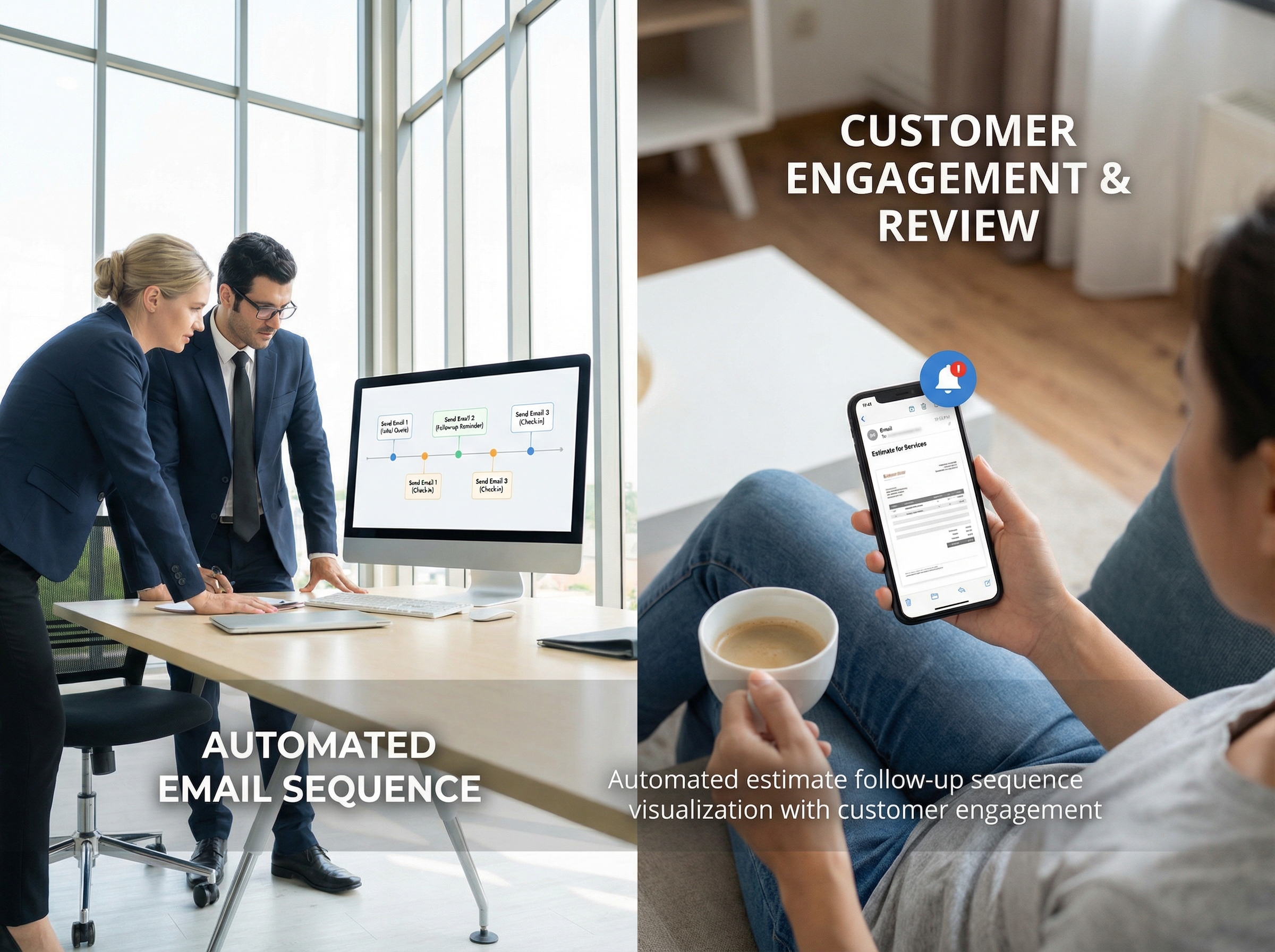
Segment follow-up sequences based on estimate value and project type. High-value projects like complete HVAC system replacements justify more intensive follow-up with additional touches and personalized content. Smaller repair estimates need lighter sequences that stay helpful without becoming annoying.
Set up behavioral triggers that modify sequences based on engagement. If a customer clicks the estimate link multiple times or visits your reviews page, flag them as hot prospects for immediate personal follow-up. If emails go unopened, switch to text message follow-ups which often get better engagement for busy homeowners.
Home services businesses experience predictable seasonal demand patterns. Smart contractors use automation to stimulate demand during slower periods and capture revenue from recurring maintenance services.
Segment your customer database by service history and equipment age. Customers who had AC installation or repairs in previous years should receive spring maintenance reminders. Furnace customers get fall tune-up campaigns. Water heater customers receive safety inspection reminders based on installation dates. This segmentation ensures messaging is relevant and timely.
Seasonal campaigns should provide value beyond sales pitches. Share tips for optimal equipment performance, warnings about common seasonal issues, and explanations of why preventive maintenance saves money compared to emergency repairs. Include customer testimonials from people who avoided costly breakdowns through regular maintenance. Offer early-bird discounts or membership plans that incentivize scheduling before peak season.
Automate campaign timing to reach customers at optimal moments. HVAC maintenance campaigns should launch 6-8 weeks before season starts, giving customers time to schedule before your calendar fills. Plumbing winterization reminders go out in early fall. Generator maintenance campaigns precede storm season. Strategic timing maximizes response rates and ensures you're not scrambling to handle campaign responses during your busiest periods.
Your existing customer database contains significant untapped revenue. Homeowners who used your services previously already trust your business, but they may have forgotten about you, switched to competitors, or simply haven't needed services recently. Reactivation campaigns bring these dormant customers back to life.
Identify customers who haven't used your services in 12-24 months. Exclude those with negative experiences or who explicitly opted out. Segment remaining contacts by service history—HVAC customers, plumbing customers, electrical customers—to deliver targeted messaging relevant to their previous interactions.
Reactivation messaging should acknowledge the gap and provide compelling reasons to re-engage. "We haven't seen you in a while and wanted to check in" feels more personal than generic promotions. Highlight what's new—new services you offer, expanded service areas, new team members, upgraded equipment, or improved processes. Include a special "welcome back" offer that incentivizes rebooking.
Multi-channel reactivation campaigns perform better than email alone. Combine email, direct mail, and SMS for maximum reach. Some customers will respond to email, others prefer text messages, and direct mail pieces often get attention in ways digital messages don't. Test different channels and combinations to find what works best for your specific customer base.
Lead generation and marketing automation must work as an integrated system. Disconnected tools create gaps where leads fall through cracks, duplicate efforts waste resources, and reporting becomes impossible.
Your Customer Relationship Management system serves as the central hub connecting all marketing and operational activities. Every lead, regardless of source, should flow automatically into your CRM where it triggers appropriate nurture workflows and becomes accessible to your team.
Ensure your CRM captures comprehensive data about each lead: contact information, service interest, source (which ad, landing page, or referral partner), geographic location, property details if provided, urgency level, and budget indicators. This data enables intelligent routing, personalized follow-up, and accurate ROI measurement.
Configure your CRM to trigger automation based on lead characteristics and behaviors. High-value leads from Local Services Ads might trigger immediate sales team notifications plus premium nurture sequences. Lower-intent leads from content downloads enter educational sequences that build trust over time. Emergency service requests trigger instant SMS notifications to on-call technicians plus automated acknowledgment to the customer.
Every marketing channel should direct traffic to dedicated landing pages optimized for conversion. Generic website homepages don't convert paid traffic effectively because they present too many options and lack focus on the specific promise that attracted the visitor.
High-converting home services landing pages include a clear, benefit-focused headline that matches ad messaging, trust indicators like licenses, insurance, certifications, and years in business, customer reviews and testimonials specific to the service offered, clear explanation of your process and what customers can expect, prominent call-to-action buttons for phone calls and form submissions, and mobile-optimized design since most traffic comes from smartphones.
Implement systematic A/B testing to improve landing page performance. Test different headlines, form lengths, trust badge placements, and call-to-action button colors. Even small improvements in conversion rates compound significantly when applied to consistent paid traffic. A landing page converting at 8% instead of 5% generates 60% more leads from the same ad spend.
Phone calls remain the primary conversion path for home services leads. Most homeowners prefer speaking with someone directly, especially for emergency situations or high-value projects. Yet many contractors lack visibility into which marketing channels drive phone leads.
Dynamic call tracking assigns unique phone numbers to different marketing channels and campaigns. Your Google Ads use different tracking numbers than Facebook ads. Your website displays different numbers to visitors from organic search versus paid search. This attribution data reveals which channels generate phone leads, not just form submissions.
Advanced call tracking systems include conversation intelligence that records and analyzes calls. These systems can automatically score calls based on length and content, identifying which calls resulted in booked appointments versus informational inquiries. This data helps you calculate true cost per booked job rather than just cost per lead—a critical distinction for understanding marketing ROI.
Integrate call tracking with your automation platform to trigger follow-up sequences based on call outcomes. Calls that didn't result in immediate booking automatically enter nurture workflows. Calls that mentioned competitors trigger differentiation sequences highlighting your unique advantages. Calls expressing price concerns receive financing information and value justification content.
Once you've established foundational automation workflows, advanced strategies multiply results by adding sophisticated personalization, predictive capabilities, and omnichannel coordination.
Not all leads are created equal. Some are ready to book immediately, others are months away from making decisions, and some will never convert. Lead scoring helps you prioritize follow-up efforts and customize communication intensity based on conversion probability.
Effective AI-powered lead scoring systems consider multiple factors: demographic fit (homeowner in service area, property type), service interest (emergency need scores higher than general inquiry), engagement level (opened emails, clicked links, visited website multiple times), and source quality (referrals and Local Services Ads typically convert better than cold website traffic). Assign point values to each factor and set thresholds that trigger different actions.
Monitor specific behaviors that indicate heightened interest. A lead who opens estimate follow-up emails three times in one day is showing strong buying signals. Someone who visits your reviews page, then returns to check your service area page, is likely vetting you against competitors. These behaviors should trigger immediate sales team notifications or accelerated follow-up sequences.
Implement negative scoring for behaviors indicating low intent. Leads who consistently ignore communications for weeks, email addresses that bounce, or contacts who opt out of messages should have scores decreased or be removed from active sequences. This prevents wasted effort on unlikely prospects and keeps your team focused on winnable opportunities.
Text message marketing achieves open rates above 95%, far exceeding email's typical 20-30% open rates. For time-sensitive communications and appointment reminders, SMS is often the most effective channel.
Strategic SMS automation includes appointment confirmations sent immediately after booking, reminders sent 24 hours and 2 hours before scheduled appointments to reduce no-shows, technician en-route notifications with estimated arrival times, post-service follow-up requests for feedback or reviews, and emergency availability alerts to customers who previously expressed interest but didn't book.
SMS requires careful execution to avoid annoying recipients. Always obtain explicit opt-in consent before sending marketing texts. Keep messages brief and focused on single clear actions. Include opt-out instructions in initial messages. Limit frequency—even engaged customers don't want daily texts. Personalize messages with customer names and specific service details to distinguish your communications from spam.
Integrate SMS with other channels in coordinated campaigns. A prospect might receive an estimate via email, a follow-up text three days later, another email after a week, and a final text before a limited-time offer expires. This multi-channel approach increases total reach and accommodates different communication preferences.
Online reviews directly influence conversion rates. Homeowners researching contractors read reviews carefully, and businesses with more positive reviews win more jobs. Yet most contractors struggle to consistently generate reviews because manually requesting them is time-consuming and easy to forget.
Automated review requests solve this problem by systematically asking satisfied customers at optimal moments. The best time to request reviews is immediately after successful service completion when satisfaction is highest. Configure your system to automatically send review requests 2-4 hours after you mark a job as complete in your CRM—enough time for the customer to experience the results but while the positive experience is still fresh.
Effective review requests are personal and make the process easy. "Thanks for choosing [Company Name] for your [service]. We'd appreciate if you could share your experience" feels more genuine than generic templates. Include direct links to your Google Business Profile, Facebook page, and other relevant review platforms. Some customers prefer Google, others use Facebook, and providing options increases response rates.
Automate review monitoring and response workflows. Set up alerts that notify you immediately when new reviews appear on any platform. Respond promptly to all reviews, thanking positive reviewers and addressing concerns in negative reviews professionally. Some platforms allow automated thank-you messages for positive reviews, though personalized responses perform better.
Acquiring new customers costs significantly more than retaining existing ones. Home services businesses with strong retention programs enjoy more predictable revenue, higher profit margins, and valuable word-of-mouth marketing.
Customer lifecycle automation segments your database by relationship stage and delivers appropriate communication for each phase. New customers receive welcome series that educate them about your services and set expectations. Active customers get seasonal maintenance reminders and educational content. At-risk customers who haven't engaged recently enter reactivation campaigns. Long-term loyal customers receive VIP treatment with exclusive offers and early access to new services.
Maintenance agreement programs benefit enormously from automation. Members receive automated appointment scheduling reminders based on their coverage terms, automated payment processing for recurring fees, priority booking confirmations, exclusive member-only promotions, and year-end summaries showing the value they received through membership. This systematic communication reduces churn and increases member satisfaction.
Create automation triggers based on equipment age and expected lifecycle. When a customer's water heater approaches 10 years old, automation can send educational content about signs of wear and replacement benefits. HVAC systems approaching 15 years trigger efficiency upgrade campaigns. This proactive approach positions you as a trusted advisor rather than a reactive repair service, and captures replacement revenue before customers start shopping competitors.
Marketing automation generates enormous amounts of data. Converting this data into actionable insights separates effective automation from expensive busy work.
Focus your measurement on metrics that directly impact business outcomes rather than vanity metrics that look good but don't correlate with revenue.
Conversion rate by source measures what percentage of leads from each channel become booked jobs. This metric reveals which lead sources are worth expanding and which need improvement or elimination. Cost per booked job calculates total marketing spend divided by jobs won, accounting for leads that never converted. This is more valuable than cost per lead because it reflects actual business impact. Average job value by source shows whether different marketing channels attract different customer segments—some sources may generate more leads at lower value while others produce fewer but higher-value projects.
Response time metrics track how quickly leads receive initial contact and follow-up. Faster response correlates directly with higher conversion rates. Email engagement rates measure open rates, click rates, and conversion rates for different message types and sequences. Low engagement indicates messaging problems or audience targeting issues. SMS response rates show which text messages drive action versus which get ignored. A/B testing helps optimize message content, timing, and calls-to-action.
Customer retention rate measures what percentage of customers return for additional services within defined timeframes. Higher retention indicates effective communication and service quality. Lifetime value by acquisition source reveals which marketing channels attract customers who generate the most long-term revenue through repeated business and referrals. Review generation rate tracks what percentage of completed jobs result in online reviews. This metric indicates both customer satisfaction and the effectiveness of your review request automation.
Most home services customers interact with your business multiple times across several channels before booking. Someone might first see your Facebook ad, visit your website, read reviews on Google, receive a seasonal promotion email, and then call to book service. Which channel deserves credit for that conversion?
First-touch attribution credits the initial interaction, recognizing channels that create awareness. Last-touch attribution credits the final interaction before conversion, highlighting channels that close deals. Multi-touch attribution distributes credit across all interactions, providing a more complete picture of customer journey. Most contractors benefit from last-touch or multi-touch models because they reveal which marketing efforts actually drive decisions rather than just initial awareness.
Implement attribution tracking through unified analytics that connect your advertising platforms, website, CRM, and call tracking. Google Analytics 4 offers improved multi-channel tracking capabilities. Marketing automation platforms with built-in CRM functionality can track complete customer journeys from first visit through closed deal. This visibility enables smarter budget allocation and campaign optimization.
Marketing automation is not a set-it-and-forget-it solution. Top-performing contractors implement systematic optimization processes that continually improve results.
Establish a regular testing calendar. Each month, identify 2-3 elements to test: email subject lines, landing page headlines, call-to-action button text, follow-up timing, offer structures, or message segmentation. Run controlled A/B tests where one variable changes while others remain constant. Measure results over sufficient sample sizes—typically 100+ conversions per variation—before declaring winners.
Conduct quarterly performance reviews analyzing trends across longer timeframes. Are certain lead sources improving or declining? Are seasonal campaigns performing better or worse than previous years? Are customer retention rates trending positively? These reviews identify strategic adjustments beyond tactical optimizations.
Monitor competitor marketing activities and industry benchmarks. If your cost per lead increases while industry averages decrease, you're losing competitive position. If competitors adopt new channels or tactics successfully, evaluate whether similar approaches could work for your business. Join industry groups and forums where contractors share anonymized performance data and best practices.
Implementing comprehensive marketing automation can seem overwhelming. This phased approach allows you to build capabilities systematically while generating results at each stage.
Establish core infrastructure and immediate response automation that delivers quick wins.
Select and implement your CRM platform, ensuring it integrates with your website, phone system, and key marketing channels. Configure basic contact management, job tracking, and reporting. Set up immediate response automation for all lead sources—website forms, phone calls, text messages, and social media inquiries. Create templates for instant acknowledgment via SMS and email. Implement basic call tracking to measure phone lead sources. Configure your website with tracking numbers that identify traffic sources for incoming calls. Launch or optimize your Google Business Profile with complete information, regular posts, and review solicitation. This free channel often delivers immediate lead volume increases.
Build automated sequences that nurture leads and drive conversions without manual effort.
Create estimate follow-up sequences that keep your proposals top-of-mind for 2-3 weeks after delivery. Include value reinforcement, social proof, and incentives to encourage decisions. Develop seasonal maintenance campaigns targeting your existing customer base. Start with your highest-volume service and expand to others once the system is working. Implement review generation automation that systematically requests reviews after every successful job completion. Establish geographic and demographic targeting for paid advertising campaigns on Google and Facebook, ensuring leads flow directly into your CRM and trigger appropriate nurture sequences.
Add sophisticated personalization, predictive capabilities, and retention programs.
Implement lead scoring based on demographic fit, engagement behavior, and source quality. Configure different follow-up intensities for high-score versus low-score leads. Create customer lifecycle segments and develop appropriate communication for each stage—new customers, active customers, at-risk customers, and VIP customers. Launch maintenance agreement or membership programs with automated benefits delivery, payment processing, and member communication. Develop equipment lifecycle triggers that proactively market replacement or upgrade services when customer equipment approaches end of expected life.
Establish systematic processes for continuous improvement.
Implement comprehensive analytics tracking all key metrics: conversion rates by source, cost per booked job, customer lifetime value, retention rates, and campaign ROI. Build dashboards that make this data accessible and actionable. Create a testing calendar that identifies optimization opportunities each month. Run controlled A/B tests and implement winning variations. Conduct quarterly strategy reviews analyzing performance trends, competitive dynamics, and emerging opportunities. Adjust channel mix, budget allocation, and messaging based on results.
Many contractors implement marketing automation with high expectations but achieve disappointing results. Understanding common mistakes helps you avoid them.
Installing automation software doesn't automatically generate results. You need clear strategy defining target customers, value propositions, and customer journey maps before building workflows.
Start with customer research. Who are your most profitable customers? What motivated them to choose your business? What concerns almost prevented them from buying? Use these insights to create personas and journey maps that inform your automation strategy. Your workflows should address real customer needs and questions at each decision stage.
Some contractors automate so aggressively that customers feel they're interacting with robots rather than a local service business. This undermines the personal relationships that differentiate small contractors from national franchises.
Balance automation with personal touchpoints. Automate immediate acknowledgment, appointment reminders, and review requests. Keep sales conversations, estimate presentations, and problem resolution personal. Use automation to enhance human capabilities rather than replace them entirely. Include your team's names, photos, and personal signatures in automated messages to maintain human connection.
Automation amplifies whatever you feed it. If your CRM contains duplicate contacts, incorrect information, and incomplete records, your automation will deliver the wrong messages to the wrong people at the wrong times.
Implement data quality standards from day one. Require complete contact information for all new leads. Regularly audit your database to identify and merge duplicates, correct errors, and remove invalid contacts. Use form validation on your website to ensure people enter properly formatted phone numbers and email addresses. Clean data makes every automation workflow more effective.
With 56% of home services searches happening on mobile devices, any friction in your mobile experience costs you leads and revenue. Websites that don't load quickly, forms that are difficult to complete on small screens, and emails that don't render properly on mobile all undermine your automation effectiveness.
Test everything on mobile devices. Your website, landing pages, forms, and email templates must provide excellent mobile experiences. Use mobile-first design principles, large touch-friendly buttons, short forms, and responsive layouts that adapt to different screen sizes. Test email templates on multiple devices and email clients before deploying campaigns.
Marketing automation technology continues evolving rapidly. Understanding emerging trends helps you prepare for competitive advantages.
Artificial intelligence is moving marketing automation from reactive to predictive. Instead of waiting for customers to exhibit certain behaviors, AI analyzes patterns across thousands of interactions to predict which customers are likely to need services, which leads are most likely to convert, and which messages will resonate most effectively.
Expect AI-powered systems that automatically optimize send times based on individual engagement patterns, predict equipment failure before it happens and trigger proactive service offers, generate personalized message content for each recipient, and continuously adjust lead scoring models based on actual conversion outcomes rather than static rules.
Voice-activated devices like Amazon Alexa and Google Home are changing how people search for services. "Alexa, find a plumber near me" represents a growing search behavior that requires optimization strategies different from traditional text search.
Prepare for voice search by claiming your business profiles on voice platforms, optimizing content for conversational queries using natural language, and ensuring your Google Business Profile is complete and accurate since voice assistants pull results from local search. As smart home devices become more prevalent, integration opportunities will emerge—imagine HVAC systems that automatically schedule maintenance when sensors detect performance issues.
Increasing privacy regulations and browser changes are limiting third-party tracking and cookie-based advertising. This shift makes first-party data—information you collect directly from customers—increasingly valuable.
Build first-party data assets by maintaining high-quality CRM data with proper consent, offering valuable content that encourages email opt-ins, implementing loyalty programs that incentivize sharing preferences and information, and using your owned channels (email, SMS, direct mail) rather than relying exclusively on rented advertising platforms. Contractors who build strong first-party databases will have competitive advantages as privacy restrictions tighten.
Marketing automation represents a fundamental shift in how home services contractors generate and convert leads. The data is compelling: companies implementing automation see average returns of $5.44 for every dollar spent, with home services contractors specifically achieving 300-500% ROI within the first year. These results aren't limited to large enterprises—contractors of all sizes can implement automation systems that capture more leads, nurture them efficiently, and convert them at higher rates.
The competitive landscape is shifting rapidly. Early automation adopters are building significant advantages in lead conversion rates, customer retention, and marketing efficiency. As more contractors recognize these benefits and implement automation, not having these capabilities will increasingly put you at a disadvantage. The question isn't whether to automate, but how quickly you can implement effective systems.
Start with the foundation: establish your CRM infrastructure, implement immediate response automation, and optimize your local search presence. These foundational elements deliver immediate results while creating the platform for more sophisticated capabilities. Build systematically through core nurture workflows, advanced personalization, and continuous optimization.
Focus relentlessly on measurement and optimization. Marketing automation generates unprecedented visibility into what's working and what isn't. Use this data to continually refine your approach, eliminate underperforming activities, and double down on tactics delivering results. The contractors who win aren't necessarily those with the most sophisticated technology—they're those who use data to make smarter decisions faster than competitors.
Remember that automation should enhance, not replace, the personal relationships that differentiate local contractors from national franchises. Use technology to handle repetitive tasks efficiently while freeing your team to focus on high-value personal interactions with customers. The combination of technological efficiency and personal service creates unbeatable competitive positioning.
The home services market will continue growing, with the remodeling market alone expected to reach $509 billion in 2025. Marketing automation helps you capture your share of this growth by ensuring no lead falls through the cracks, every customer receives excellent communication, and your business stays top-of-mind when homeowners need services. The implementation roadmap outlined in this playbook provides your path forward. Start today, build systematically, measure results, and optimize continuously. Your future success depends on the systems you build now.

As a beacon of innovation, we guide your business through the evolving digital landscape with cutting-edge solutions.

Our steadfast reliability anchors your strategic endeavors, ensuring consistent delivery and performance.

We harness state-of-the-art technology to provide smart, scalable solutions for your digital challenges.

Our extensive experience in the digital domain translates into a rich tapestry of success for your brand.

Upholding the highest standards of digital security, we protect your business interests with unwavering vigilance.

We offer a stable platform in the tumultuous digital market, ensuring your brand's enduring presence and growth.
OmniFunnel Marketing has garnered notable recognition from a range of prestigious media outlets. This acknowledgment from leading publications not only underscores our expertise in the digital marketing realm but also highlights our commitment to delivering exceptional marketing strategies. Our presence in these prominent media sources is a testament to the trust and value we bring to our clients, elevating their marketing efforts to new heights.





As a beacon of innovation, we guide your business through the evolving digital landscape with cutting-edge solutions.
Our steadfast reliability anchors your strategic endeavors, ensuring consistent delivery and performance.
We harness state-of-the-art technology to provide smart, scalable solutions for your digital challenges.
Our extensive experience in the digital domain translates into a rich tapestry of success for your brand.
Upholding the highest standards of digital security, we protect your business interests with unwavering vigilance.
We offer a stable platform in the tumultuous digital market, ensuring your brand's enduring presence and growth.

Experienced Senior Teams
Profit-First Strategy & Consulting
Channel-Specific Paid Media
Tracking & Attribution Specialists
Conversion Rate Optimization (CRO)
In-House Developers
In-House Creative Production
Proprietary First-Party Data Priming
Full-Funnel Feedback Loops
AI Voice Agents & Automated
AI Content Engine
MCP + LLM Real-Time Optimization
Value-Based Bidding & ROI
Installed CMO Leadership
You Own All Assets






Our talented team brings 20+ years of expertise and passion.

Michael Tate, CEO and Co-Founder of OmniFunnel Marketing, is a pioneering leader in leveraging AI and machine learning (ML) technologies to revolutionize digital marketing. With over 20 years of expertise in new media sales, Michael has distinguished himself as an SEO/SEM specialist, adept at integrating AI-driven strategies to enhance paid performance marketing. Since January 2016, he has been instrumental in transforming OmniFunnel Marketing into a hub of innovation, particularly in the legal and medical sectors. His philosophy, “more visibility without more expenditure,” is brought to life through AI-powered marketing tools, offering small and medium-sized firms a competitive edge.
His role involves not just client engagement but also orchestrating AI and ML tools to optimize marketing strategies for ROI maximization. Michael's expertise in AI-driven data analysis and workflow automation enables businesses to achieve unprecedented productivity and efficiency, ensuring robust online presence and profitability.
.webp)
Former foreign policy advisor turned digital marketing and communications consultant, Kalinda's extensive professional journey spans nearly two decades across both public and private sectors. Her expertise lies in strategic and creative marketing strategy, as well as communications management for businesses, associations, and government agencies. Having lived and worked globally, she has had the privilege of assisting businesses—both in the US and abroad—achieve their goals through impactful social media campaigns, community building, outreach, brand recognition, press relations, and corporate communication.
Kalinda's passion lies in cultivating meaningful relationships among stakeholders while building lasting digital brands. Her signature approach involves delving into each client’s unique needs and objectives from the outset, providing highly customized, bespoke service based on their needs. From political leaders to multi-unit restaurant concepts and multi-million dollar brands, Kalinda has successfully guided a diverse range of clients reach and exceed their digital marketing, public relations, and sales goals.

OmniFunnel Marketing's Director of Search Marketing, brings close to 15 years of digital marketing experience to leading the agency's paid media strategy. A dedicated Google Ads specialist at his core, Juan's command extends across Meta, TikTok, and Amazon, with a primary focus on ecommerce and an equally sharp discipline in lead generation. He has built and scaled campaigns across virtually every vertical, from local service businesses to national, multi-market accounts, and his leadership has been central to establishing paid media as one of OmniFunnel's most consistent growth engines.
What separates Juan's work is the conviction that campaigns are only as good as the signal beneath them. Before a dollar scales, he pressure tests the full measurement layer, tracking architecture, event design, and the quality of the conversion data flowing back to each platform, and he operates daily inside attribution platforms like Triple Whale and Northbeam, reconciling what Meta, Google, TikTok, and Amazon each claim against what the business actually banked. That foundation powers the fundamentals that move results: precise account structure, disciplined budget management, and relentless, data-driven testing and optimization, increasingly paired with AI-powered tools to sharpen targeting and surface insights faster. The combination lets OmniFunnel Marketing scale client accounts sustainably, growing spend and revenue in tandem while delivering measurable, lasting business growth.

Camila is a pioneering digital marketing leader who began shaping influencer strategy before it became an industry standard, partnering with mega brands like H&M, Universal Music, FabFitFun, FoxyBae, and Amika to name a few. An early adopter and entrepreneur, she evolved from affiliate manager to blogger to 7-figure ecommerce brand founder, and later accelerated growth for an innovative Silicon Valley software startup redefining personal health data ownership and user empowerment. Along the way, she played a pivotal role in educating leading global agencies, including Starcom, Ogilvy, and Universal McCann, on the power of influencer marketing in its formative years.
At OmniFunnel Marketing, Camila leads creative across every major social platform, Meta, Instagram, TikTok, YouTube, and beyond, carrying concepts from insight through finished production, often in front of the camera herself. She owns the full customer lifecycle as well, with expert command of email and SMS automation inside platforms like Klaviyo, building the flows, segmentation, and campaigns that turn first purchases into durable repeat revenue. With deep expertise in customer acquisition, scalable strategy, and trend forecasting, Camila bridges the gap between people and brands, aligning KPIs with market realities while delivering measurable growth. She remains at the forefront of digital innovation, integrating the power of AI with human insight to fuel growth, relevance, and long-term brand value.

Emma Harris, Chief Operating Officer (COO) of OmniFunnel Marketing, Emma plays a pivotal role in steering the operational direction and strategy of the agency. Her responsibilities are multi-faceted, encompassing various aspects of the agency's operations.
Emma utilizes her extensive operational experience to lead and oversee the agency's day-to-day operations. She is responsible for developing and implementing operational strategies that align with the agency's long-term goals and objectives. Her strategic mindset enables her to foresee market trends and adapt operational strategies accordingly, ensuring the agency remains agile and competitive.

Joseph Pagan, OmniFunnel Marketing's Director of Design & Development, is a visionary in integrating AI and ML into creative design and web development. His belief in the synergy of UI/UX, coding, and AI technologies has been pivotal in advancing OmniFunnel's design and development frontiers. Joseph has led his department in leveraging AI and workflow automation to create websites that are not only aesthetically pleasing but highly functional and intuitive
His approach involves using advanced AI tools to streamline web development processes, ensuring adherence to top-notch coding standards and design guidelines. This leads to enhanced efficiency, accuracy, and client satisfaction. Joseph's extensive experience across different design and development domains, combined with his proficiency in AI and ML, empowers OmniFunnel Marketing to deliver cutting-edge, user-centric digital solutions that drive business growth and customer engagement.

Sarah Martinez, as the Marketing Manager at OmniFunnel Marketing, holds a crucial role in shaping and executing the marketing strategies of the agency. Her responsibilities are diverse and impactful, directly influencing the brand's growth and presence in the market.
Sarah is responsible for crafting and overseeing the execution of marketing campaigns. This involves understanding the agency's objectives, identifying target audiences, and developing strategies that effectively communicate the brand's message. She ensures that each campaign is innovative, aligns with the agency's goals, and resonates with the intended audience.
Discover Success Stories from OmniFunnel's Diverse Portfolio.
Dive into the narratives of our clients who have embraced OmniFunnel's AI-driven marketing solutions to monumental success. Their experiences underscore our commitment to harnessing artificial intelligence for strategic marketing that not only reaches but resonates with target audiences, fostering robust engagement and exceptional growth.
Kevin Stranahan
Jane Martinez
David Butler
Discover Success Stories from OmniFunnel's Diverse Portfolio.
Dive into the narratives of our clients who have embraced OmniFunnel's AI-driven marketing solutions to monumental success. Their experiences underscore our commitment to harnessing artificial intelligence for strategic marketing that not only reaches but resonates with target audiences, fostering robust engagement and exceptional growth.
"OFM's expertise in eCommerce marketing is unparalleled. They optimized our PPC campaigns, revamping our ad spend to yield an astounding ROI. If you're looking to make waves in the digital world, look no further than OFM."
Kevin Stranahan
"Transparency and innovation are at the core of OFM’s services. Their monthly reports are comprehensive, and their readiness to adapt and innovate is remarkable. We've finally found a digital marketing agency we can trust for the long haul."
Jane Martinez
"OmniFunnel's AI solutions have exceeded our expectations and delivered outstanding results."
David Butler
Discover Success Stories from OmniFunnel's Diverse Portfolio.
Dive into the narratives of our clients who have embraced OmniFunnel's AI-driven marketing solutions to monumental success. Their experiences underscore our commitment to harnessing artificial intelligence for strategic marketing that not only reaches but resonates with target audiences, fostering robust engagement and exceptional growth.
"OFM's expertise in eCommerce marketing is unparalleled. They optimized our PPC campaigns, revamping our ad spend to yield an astounding ROI. If you're looking to make waves in the digital world, look no further than OFM."
Kevin Stranahan
"Transparency and innovation are at the core of OFM’s services. Their monthly reports are comprehensive, and their readiness to adapt and innovate is remarkable. We've finally found a digital marketing agency we can trust for the long haul."
Jane Martinez
"OmniFunnel's AI solutions have exceeded our expectations and delivered outstanding results."
David Butler
At OmniFunnel Marketing, we pride ourselves on being a beacon of innovation and excellence in the digital marketing world. As an award-winning agency, we are celebrated for our pioneering strategies and creative ingenuity across the digital landscape. Our expertise is not confined to a single aspect of digital marketing; rather, it encompasses a full spectrum of services, from SEO and PPC to social media and content marketing. Each campaign we undertake is an opportunity to demonstrate our skill in driving transformative results, making us a trusted partner for businesses seeking to navigate and excel in the complex digital arena. Our holistic approach ensures that every facet of digital marketing is leveraged to elevate your brand, engage your audience, and achieve outstanding growth and success



.webp)







Ready to level up your online game? Call (844) 200-6112 or dive into the form below.