













Get In Touch
Contact Us Today for a
Comprehensive Analysis and Strategy Session.
Ready to level up your online game? Call (844) 200-6112 or dive into the form below.
Embrace the future of collaboration with OmniFunnel's Oculus 2 VR headset offer for valued clients. It's your entry into immersive VR meetings in the metaverse, redefining digital meetings and shaping virtual collaboration in the realm of web3.
LinkedIn advertising has become increasingly expensive for B2B marketers. With cost per lead routinely exceeding $100 for technology companies and some campaigns reaching $150 or higher, the pressure to optimize targeting has never been greater. Yet most advertisers approach LinkedIn with the same broad targeting strategies they use on other platforms, resulting in wasted budgets and inflated acquisition costs.
The reality is that LinkedIn Ads costs have surged 8% year-over-year, making precision targeting not just advantageous but essential for campaign profitability. However, sophisticated targeting tactics can cut your cost per lead in half while actually improving lead quality. This comprehensive guide reveals the advanced targeting strategies that separate high-performing LinkedIn campaigns from those that drain budgets without delivering results.
At OmniFunnel Marketing, we've managed LinkedIn ad campaigns across hundreds of B2B clients, consistently achieving CPLs 40-50% below industry benchmarks. Our approach combines LinkedIn's powerful professional targeting capabilities with AI-driven optimization and strategic audience segmentation. These tactics work whether you're spending $5,000 or $500,000 monthly on LinkedIn advertising.

Before diving into advanced tactics, you need to understand what makes LinkedIn targeting fundamentally different from other advertising platforms. LinkedIn's strength lies in professional data—job titles, company size, industry, skills, and seniority levels—creating targeting opportunities unavailable anywhere else.
Unlike Facebook's interest-based targeting or Google's intent-based approach, LinkedIn allows you to target decision-makers based on their actual professional roles and responsibilities. This precision comes with higher costs, but when executed correctly, the return on investment far exceeds other platforms for B2B campaigns.
LinkedIn Campaign Manager offers multiple targeting dimensions that can be combined to create highly specific audience segments. Understanding when and how to use each option is critical for cost optimization.
The key to reducing CPL is not using more targeting options but using the right combinations. According to LinkedIn's official best practices, you should avoid adding more than two to three targeting facets when starting campaigns, as overly narrow targeting limits scale and drives up costs.
The single most effective way to reduce CPL on LinkedIn is mastering layered job targeting. This approach combines job functions with seniority levels to reach decision-makers without the waste of broad job title targeting.
Many advertisers start with job title targeting because it seems most precise. If you're selling marketing automation software, targeting "Marketing Director" or "CMO" appears logical. However, job title targeting has significant limitations that increase costs.
Job titles vary enormously across companies. A "Marketing Director" at a 50-person startup has vastly different responsibilities and budget authority than a "Marketing Director" at a Fortune 500 company. Additionally, many professionals don't update their LinkedIn titles regularly, and some use creative or non-standard titles that won't match your targeting.
More problematically, job title targeting often creates small audience pools that force LinkedIn's algorithm to bid more aggressively, driving up your CPC and CPL. When your target audience is only 15,000 members, you'll pay premium prices to reach them.
Instead of targeting specific job titles, combine broad job functions with appropriate seniority levels. This creates larger audience pools while maintaining relevance to your ideal customer profile.
Example targeting setup for marketing software:
This combination reaches marketing decision-makers across various title formats while creating an audience large enough for LinkedIn's algorithm to optimize delivery efficiently. You'll typically see audience sizes of 100,000-300,000 members, which is the sweet spot for balancing scale and specificity.
For highly specialized offerings, skills targeting provides an alternative way to reach professionals with specific expertise. Rather than targeting "Data Science Manager," you can target professionals with skills like "Machine Learning," "Python," "Deep Learning," and "Neural Networks" combined with appropriate seniority levels.
Skills targeting captures professionals regardless of their exact job title, reaching the right expertise while maintaining audience scale. This approach works particularly well for technical B2B products and services. As noted in our guide on building smart LinkedIn ad strategies, combining multiple targeting dimensions strategically is key to scaling B2B campaigns profitably.
Matched Audiences represents LinkedIn's most powerful targeting capability for reducing CPL. By retargeting engaged prospects and known contacts, you dramatically improve conversion rates while lowering acquisition costs.
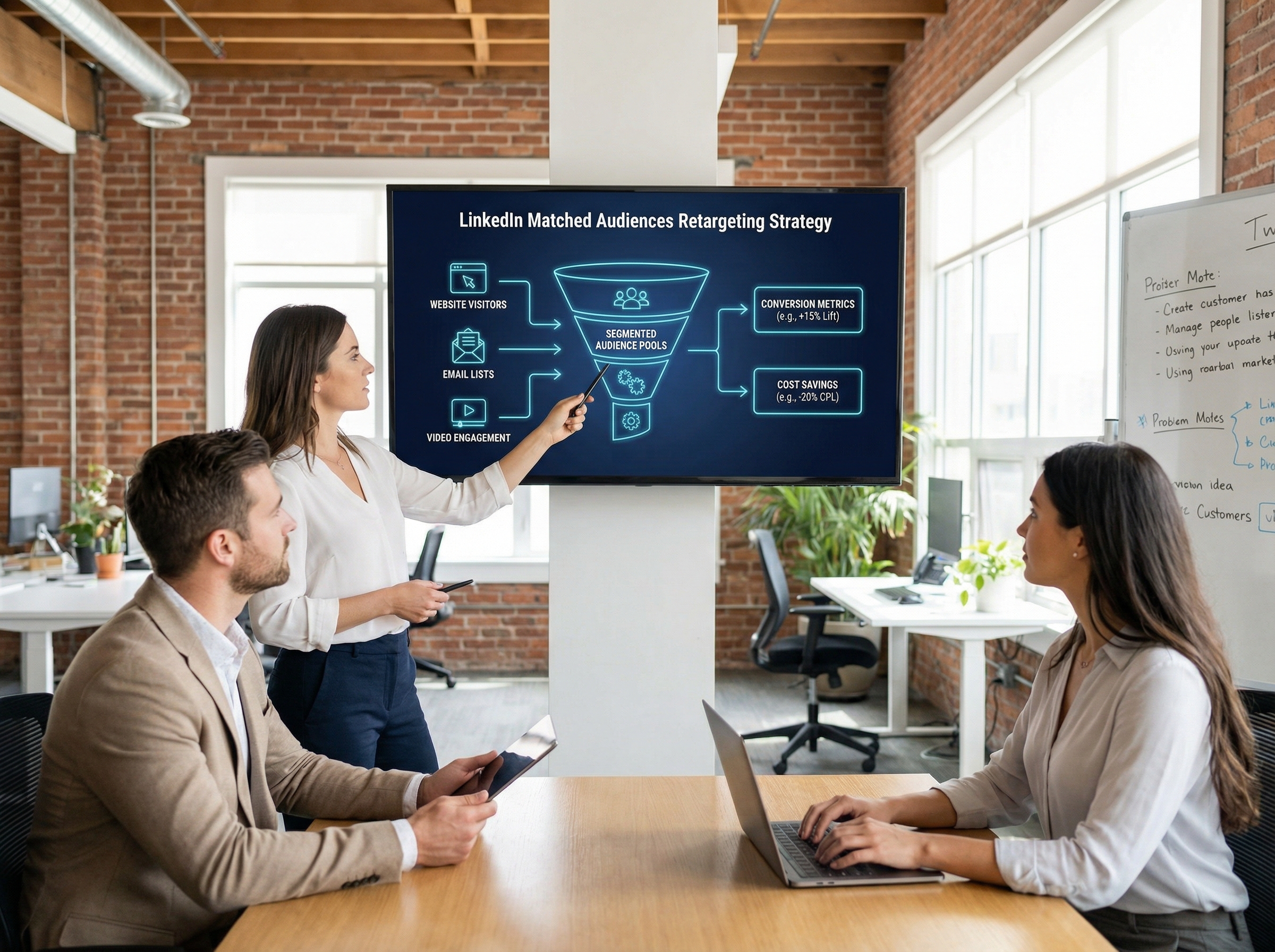
Website retargeting allows you to serve LinkedIn ads to professionals who have visited your website. This is exponentially more cost-effective than cold prospecting because you're reaching people who have already demonstrated interest in your offerings.
Implementation requires installing the LinkedIn Insight Tag on your website. Once installed, LinkedIn matches website visitors to member profiles, allowing you to create retargeting audiences based on specific pages visited or actions taken. According to LinkedIn's Matched Audiences documentation, your audience needs at least 300 member accounts to be used in campaign targeting.
Strategic segmentation for website retargeting:
Website retargeting campaigns typically achieve CPLs 50-70% lower than cold prospecting campaigns. The conversion rates are significantly higher because you're reaching professionals already familiar with your brand and solutions.
Contact list targeting allows you to upload customer or prospect email addresses and serve LinkedIn ads directly to those individuals. This is particularly powerful for nurturing sales pipeline prospects, re-engaging cold leads, and cross-selling existing customers.
LinkedIn matches your email list to member profiles with a typical match rate of 60-75%. For a list of 10,000 email addresses, you might reach 6,000-7,500 LinkedIn members. The minimum audience size is 300 matched members to activate targeting.
High-impact contact list targeting scenarios:
Contact list campaigns deliver the lowest CPL of any LinkedIn targeting method because you're reaching pre-qualified prospects with existing brand familiarity. Expect CPLs 60-80% below cold prospecting benchmarks. This approach aligns perfectly with full-funnel LinkedIn marketing strategies that nurture prospects across multiple touchpoints.
LinkedIn allows you to create retargeting audiences based on video ad engagement. You can target members who viewed 25%, 50%, 75%, or 97% of your video content, with lookback windows from 30 to 365 days.
This creates powerful sequential messaging opportunities. For example, someone who watched 75% or more of your product explainer video has demonstrated strong interest and is primed for a direct response offer. Someone who watched only 25% might need more educational content before they're ready to convert.
Run video awareness campaigns at the top of funnel, then retarget engaged viewers with conversion-focused offers. This two-step approach consistently outperforms single-stage campaigns while reducing overall CPL by 30-40%.
LinkedIn Lead Gen Forms convert at 6-10%, double the rate of external landing pages. However, that still means 90-94% of people who open your form don't complete it. Lead Gen Form retargeting allows you to re-engage these prospects who showed clear intent but didn't convert.
Create separate audiences for form openers versus form submitters. Target form openers with adjusted offers—perhaps a lighter commitment or different value proposition. Exclude form submitters from prospecting campaigns to avoid wasting budget on leads already captured.
For B2B companies with defined target account lists, company list targeting delivers the highest ROI and lowest waste. This approach focuses your entire LinkedIn budget on decision-makers at your most valuable potential customers.
LinkedIn allows you to upload lists of specific companies you want to target. You can target employees at these companies, filtering further by job function, seniority, or other criteria. The minimum requirement is 1,000 companies for list-based targeting.
Sources for building company target lists:
The key is starting with a tight ICP (Ideal Customer Profile) and building lists that match those criteria. A targeted list of 1,000-5,000 high-fit companies will outperform broader targeting of 50,000+ companies every time when measuring qualified lead generation and pipeline contribution.
Simply targeting all employees at your target accounts wastes budget on irrelevant impressions. Layer your company lists with job function and seniority targeting to reach only decision-makers and influencers.
Example ABM targeting setup:
This creates a highly focused audience of technology decision-makers at your target accounts, typically ranging from 15,000-50,000 targetable members depending on your company list size and job criteria. CPLs for well-executed ABM campaigns run 40-60% below prospecting campaign benchmarks because every impression reaches a high-value prospect. Learn more about integrating AI into your ABM strategy in our guide on building winning account-based marketing strategies with AI.
Account-based targeting enables personalized creative that references the target audience's specific industry, challenges, or context. This personalization significantly improves engagement and conversion rates.
Instead of generic messaging like "Improve your marketing ROI," ABM campaigns can use industry-specific language: "Help financial services firms meet compliance requirements while accelerating digital transformation." This relevance drives higher click-through rates and better-qualified leads.
Test multiple creative variations with different value propositions. With smaller, highly targeted audiences, creative quality has outsized impact on performance. Invest in professional design and compelling copy tailored to your target accounts' specific needs.
Most advertisers run the same campaigns to all audiences, showing identical messaging to cold prospects and warm leads. This approach wastes budget and underperforms. Strategic funnel-based segmentation cuts CPL by matching message to awareness level.
Top of funnel campaigns reach cold prospects who may not know your brand or fully understand their problem. The goal is awareness and education, not immediate conversion.
TOFU targeting approach:
TOFU campaigns should optimize for engagement and awareness metrics rather than immediate lead generation. Accept higher CPL at this stage—you're building audiences for more efficient retargeting. Video content performs particularly well for TOFU campaigns, with LinkedIn's video inventory up 74% in 2025 reflecting increased demand for this format.
Middle of funnel targets warm audiences who have engaged with your brand but haven't converted. This is where Matched Audiences delivers maximum value.
MOFU targeting approach:
MOFU content focuses on differentiation and proof: case studies, product comparisons, ROI calculators, demo videos, and customer testimonials. The messaging shifts from education to persuasion, addressing objections and demonstrating value.
MOFU campaigns typically deliver CPLs 40-50% lower than TOFU while generating higher-quality leads with better sales qualification rates. This is where most of your budget should concentrate once you've built retargeting audiences.
Bottom of funnel campaigns target high-intent prospects showing clear buying signals. These audiences are small but extremely valuable.
BOFU targeting approach:
BOFU offers focus on removing final barriers to conversion: free trials, personalized demos, limited-time discounts, money-back guarantees, or expedited implementation. The creative emphasizes urgency and clear calls-to-action.
BOFU campaigns deliver the lowest CPL and highest conversion rates—often 70-80% below cold prospecting benchmarks. However, audience sizes are small, limiting total volume. This is why funnel-based strategies require all three stages working together.
Reducing CPL isn't just about who you target—it's equally about who you exclude. Strategic negative targeting eliminates wasted impressions and focuses budget on genuine prospects.
The most obvious exclusion is current customers. Upload your customer email list as a Matched Audience and exclude it from prospecting campaigns. This prevents wasting budget convincing people who have already bought.
Exception: Run separate campaigns to existing customers for upsell, cross-sell, or retention purposes. But keep these campaigns distinct with appropriate messaging and budget allocation.
If you're selling enterprise software requiring C-level approval, exclude entry-level and individual contributor seniority levels. They may click your ads out of interest, but they can't become customers, inflating your CPL without contributing to pipeline.
Use seniority exclusions strategically based on your sales cycle and buying committee structure. For high-ticket B2B offerings, focus exclusively on Director level and above to maximize lead quality.
Company size targeting works both directions. If your minimum deal size requires mid-market or enterprise customers, exclude small companies that can't afford your solution. This is particularly important for targeting efficiency.
For example, if your software starts at $50,000 annually, exclude companies with 1-10 or 11-50 employees. These organizations rarely have budget for enterprise solutions, and their clicks drain your budget without converting.
Certain industries may show interest in your offering but have low conversion rates or poor customer economics. Identify these through campaign data analysis and exclude them from future targeting.
If your analytics show that non-profit organizations click your ads but convert at 10% the rate of for-profit businesses, exclude non-profits from prospecting campaigns. Focus budget where ROI is strongest.
LinkedIn's Lookalike Audiences allow you to find new prospects similar to your best customers. This combines the precision of customer data with the scale needed for significant lead volume.
Lookalike audiences start with a seed audience—typically a contact list of your best customers. LinkedIn analyzes the professional characteristics, interests, and attributes of your seed audience, then finds similar members across the platform.
Effective seed lists for lookalike modeling:
Quality of seed data matters more than quantity. A list of 500 ideal customers produces better lookalike audiences than a list of 5,000 mixed-quality leads. LinkedIn requires a minimum of 300 matched members to create lookalike audiences.
When creating lookalike audiences, you can choose expansion percentages that control audience size. Smaller percentages (1-5%) create highly similar audiences, while larger percentages (10-15%) provide more scale with less precision.
Test multiple expansion levels with separate campaigns. Start with 1-3% lookalikes for highest quality, then expand to 5-10% as you prove performance and need additional scale. This tiered approach lets you balance lead quality with volume requirements.
Well-executed lookalike campaigns typically achieve CPLs 25-40% below cold prospecting while maintaining lead quality similar to direct targeting. This makes lookalikes ideal for scaling campaigns that have proven economics at smaller audience sizes. The approach works particularly well when combined with systematic B2B lead generation strategies that emphasize quality over volume.
Beyond audience targeting, how you structure campaigns significantly impacts cost efficiency. Poor campaign structure forces LinkedIn's algorithm to work inefficiently, driving up costs even with perfect targeting.
LinkedIn's algorithm needs sufficient audience size to optimize delivery. Too small, and you'll pay premium CPCs. Too large, and you'll waste budget on irrelevant impressions.
Target audience sizes of 50,000-300,000 members for Sponsored Content campaigns. Smaller audiences (15,000-50,000) can work for Message Ads or highly targeted ABM campaigns, but expect higher costs. Audiences below 15,000 members should be avoided except for strategic high-value account lists.
If your targeting creates audiences smaller than 50,000, broaden slightly by adding complementary job functions or expanding company size ranges. If your audiences exceed 500,000, consider segmenting into multiple campaigns for more precise optimization.
There's tension between campaign consolidation for algorithmic efficiency and segmentation for precise optimization. The right balance depends on your budget and objectives.
For budgets under $10,000 monthly, consolidate into fewer campaigns with larger audiences. This gives LinkedIn's algorithm more data to optimize delivery. For budgets above $25,000 monthly, segment into multiple campaigns based on audience characteristics, funnel stage, or account value.
Test both approaches. Run a consolidated campaign targeting all MOFU audiences versus separate campaigns for each MOFU segment. Measure CPL and lead quality across both structures to determine optimal organization for your specific situation.
LinkedIn offers multiple bid strategies: maximum delivery, cost cap, and manual bidding. Each impacts CPL differently depending on campaign goals and audience characteristics.
Maximum delivery: LinkedIn automatically bids to spend your budget and maximize results. This works well for campaigns with proven conversion economics and sufficient budget. However, it can drive costs up if not monitored closely.
Cost cap: Set a target cost per result, and LinkedIn optimizes to achieve that cost on average. This provides better cost control but may limit delivery volume if your cap is too aggressive.
Manual bidding: You control exact bid amounts. This requires more active management but provides maximum control over costs. Start with LinkedIn's suggested bid range, then optimize based on performance data.
For CPL optimization, cost cap bidding usually delivers best results once you have 30 days of performance data to establish realistic targets. Start with maximum delivery to gather data, then switch to cost cap with targets 10-15% below your achieved CPL in the learning phase.
Even perfect targeting fails with poor creative. Ad copy, imagery, and offers directly impact click-through rates and conversion rates, which determine your ultimate CPL.
Different LinkedIn ad formats perform optimally at different funnel stages. Matching format to objective improves efficiency and reduces wasted spend.
Strategic ad format selection:
Test multiple formats simultaneously, but recognize each has optimal use cases. Don't expect Message Ads to efficiently generate top-of-funnel awareness, and don't rely solely on video ads for bottom-funnel conversion.
LinkedIn Lead Gen Forms consistently deliver the lowest CPL of any ad format because they eliminate friction. Forms pre-populate with LinkedIn profile data, allowing conversions with two clicks instead of navigating to landing pages and manually completing forms.
Lead Gen Forms convert at 6-10% compared to 3-5% for landing page forms. This effectively cuts your CPL in half for equivalent traffic. For campaigns focused on lead generation rather than website traffic, Lead Gen Forms should be your default choice.
Lead Gen Form optimization tactics:
Some marketers worry Lead Gen Forms generate lower-quality leads due to reduced friction. Testing consistently shows comparable or better lead quality when forms are properly designed and targeted to appropriate audiences. The key is matching offer complexity to form simplicity—high-commitment offers need more qualifying questions.
Systematic creative testing is essential for CPL optimization. Even small improvements in click-through rate or conversion rate significantly impact cost efficiency.
Creative elements to test systematically:
Run 2-3 creative variations per campaign initially. Once you identify winners, create new variations testing against the champion. This continuous optimization approach steadily reduces CPL over time as creative performance improves.
Wait for statistical significance before declaring winners. LinkedIn recommends at least 50 conversions per variation before making definitive judgments. Premature optimization based on small sample sizes often leads to poor decisions.
Reducing CPL requires accurate measurement and proper attribution. Without clear visibility into what's working, you'll optimize blindly and waste budget on ineffective tactics.
LinkedIn Campaign Manager provides valuable performance data, but it shows only LinkedIn-attributed results. This significantly understates LinkedIn's true impact on your pipeline, particularly for longer B2B sales cycles with multiple touchpoints.
Implement multi-touch attribution that tracks prospects across all interactions—LinkedIn ads, organic search, email, direct traffic, and sales outreach. This reveals LinkedIn's role in influencing deals even when it's not the last click before conversion.
Connect LinkedIn lead data to your CRM and track progression through your sales funnel. Calculate CPL based on Sales Qualified Leads (SQL) or pipeline generated, not just Marketing Qualified Leads (MQL). This aligns marketing metrics with business outcomes and reveals true campaign ROI. This approach integrates well with comprehensive B2B SaaS demand generation strategies focused on pipeline quality over vanity metrics.
CPL is important but incomplete. Monitor these additional metrics for comprehensive optimization:
Use these metrics to diagnose performance issues. High CPL with good CTR but low conversion rate indicates landing page or offer problems. High CPL with low CTR suggests targeting or creative issues. High CPL with good conversion rate but poor SQL rates means targeting wrong audience segments.
Effective optimization requires discipline and patience. Too-frequent changes prevent campaigns from exiting learning phases and gathering meaningful data. Too-infrequent optimization leaves money on the table.
Recommended optimization schedule:
Allow campaigns to run for at least 7-14 days before making major changes. LinkedIn's algorithm needs time to learn and optimize delivery. Constant tweaking resets the learning phase and prevents efficient optimization.
Even sophisticated marketers make tactical errors that unnecessarily increase LinkedIn advertising costs. Avoiding these common mistakes provides immediate CPL improvements.
Trying to be too precise with targeting creates audience pools too small for efficient optimization. Audiences below 20,000 members force higher bids and limit LinkedIn's ability to find lower-cost conversions.
If your carefully defined targeting creates audiences under 30,000 members, broaden slightly. Add complementary job functions, expand seniority ranges, or include additional company sizes. The slight reduction in precision is more than offset by improved cost efficiency and scale.
External landing pages convert at half the rate of Lead Gen Forms. Sending conversion-focused campaigns to landing pages doubles your CPL unnecessarily.
Use Lead Gen Forms for all lead generation campaigns unless you have specific reasons to drive website traffic (tracking pixels, content engagement, product trials requiring account creation). The improved conversion rates dramatically reduce CPL.
Over 60% of LinkedIn ad impressions occur on mobile devices. If your landing pages aren't mobile-optimized, you're wasting the majority of your ad spend on traffic that bounces immediately.
Test all landing pages on mobile devices before launching campaigns. Better yet, use Lead Gen Forms that provide excellent mobile experience by design. For campaigns requiring landing pages, ensure fast load times, mobile-responsive design, and simplified forms optimized for small screens.
LinkedIn campaigns generate leads, but slow or inconsistent follow-up wastes that investment. Leads contacted within 5 minutes are 21x more likely to convert than leads contacted after 30 minutes.
Implement automated lead routing and notifications. Integrate LinkedIn Lead Gen Forms directly with your CRM. Set up automated email sequences for immediate engagement. Fast, systematic follow-up improves conversion rates and reduces effective CPL by maximizing value from each lead generated.
Showing prospecting ads to people who already converted wastes budget convincing them to do what they've already done. This is surprisingly common and easily preventable.
Upload converted leads as contact lists and exclude them from prospecting campaigns. Create separate nurturing campaigns for leads in your pipeline with appropriate messaging for their stage. This segmentation prevents wasted impressions and improves overall efficiency.
These advanced targeting tactics work synergistically when implemented as a comprehensive strategy rather than isolated tactics. Here's a practical action plan for cutting your LinkedIn CPL by 50%.
LinkedIn advertising costs will continue rising as competition intensifies. Cutting your CPL by 50% isn't about finding a magic bullet—it's about systematically implementing multiple targeting tactics that compound to deliver significantly better efficiency.
The strategies outlined in this guide—layered job targeting, Matched Audiences retargeting, account-based marketing, funnel-based segmentation, strategic exclusions, and lookalike expansion—work together to eliminate wasted impressions and focus budgets on genuine prospects at the right time with the right message.
Success requires disciplined testing, accurate measurement, and continuous optimization. Start with the Phase 1 foundation tactics that deliver immediate improvements, then systematically layer in advanced strategies as you build retargeting audiences and gather performance data.
Most LinkedIn advertisers use basic targeting and accept industry-average CPLs. By implementing these advanced tactics, you'll gain significant competitive advantage—reaching the same decision-makers at half the cost while your competitors overpay for inferior targeting. That efficiency advantage translates directly to faster growth, better unit economics, and sustainable competitive positioning.
At OmniFunnel Marketing, our AI-powered approach to LinkedIn advertising combines these targeting strategies with predictive analytics and automated optimization to consistently achieve CPLs 40-50% below industry benchmarks. Our proprietary DeepML technology analyzes campaign performance across thousands of B2B clients to identify optimization opportunities human analysts might miss. When you're ready to transform your LinkedIn advertising performance, our team brings 20 years of expertise and proven methodologies that deliver measurable results.
The question isn't whether you can cut your LinkedIn CPL by 50%—it's when you'll start implementing the strategies that make it possible. The longer you wait, the more budget you waste on inefficient targeting while competitors who adopt these tactics capture market share at lower costs. Start with one tactic today, measure the results, and systematically expand your advanced targeting capabilities. Your pipeline and your CFO will thank you.

As a beacon of innovation, we guide your business through the evolving digital landscape with cutting-edge solutions.

Our steadfast reliability anchors your strategic endeavors, ensuring consistent delivery and performance.

We harness state-of-the-art technology to provide smart, scalable solutions for your digital challenges.

Our extensive experience in the digital domain translates into a rich tapestry of success for your brand.

Upholding the highest standards of digital security, we protect your business interests with unwavering vigilance.

We offer a stable platform in the tumultuous digital market, ensuring your brand's enduring presence and growth.
OmniFunnel Marketing has garnered notable recognition from a range of prestigious media outlets. This acknowledgment from leading publications not only underscores our expertise in the digital marketing realm but also highlights our commitment to delivering exceptional marketing strategies. Our presence in these prominent media sources is a testament to the trust and value we bring to our clients, elevating their marketing efforts to new heights.





As a beacon of innovation, we guide your business through the evolving digital landscape with cutting-edge solutions.
Our steadfast reliability anchors your strategic endeavors, ensuring consistent delivery and performance.
We harness state-of-the-art technology to provide smart, scalable solutions for your digital challenges.
Our extensive experience in the digital domain translates into a rich tapestry of success for your brand.
Upholding the highest standards of digital security, we protect your business interests with unwavering vigilance.
We offer a stable platform in the tumultuous digital market, ensuring your brand's enduring presence and growth.

Experienced Senior Teams
Profit-First Strategy & Consulting
Channel-Specific Paid Media
Tracking & Attribution Specialists
Conversion Rate Optimization (CRO)
In-House Developers
In-House Creative Production
Proprietary First-Party Data Priming
Full-Funnel Feedback Loops
AI Voice Agents & Automated
AI Content Engine
MCP + LLM Real-Time Optimization
Value-Based Bidding & ROI
Installed CMO Leadership
You Own All Assets



Our talented team brings 20+ years of expertise and passion.

Michael Tate, CEO and Co-Founder of OmniFunnel Marketing, is a pioneering leader in leveraging AI and machine learning (ML) technologies to revolutionize digital marketing. With over 20 years of expertise in new media sales, Michael has distinguished himself as an SEO/SEM specialist, adept at integrating AI-driven strategies to enhance paid performance marketing. Since January 2016, he has been instrumental in transforming OmniFunnel Marketing into a hub of innovation, particularly in the legal and medical sectors. His philosophy, “more visibility without more expenditure,” is brought to life through AI-powered marketing tools, offering small and medium-sized firms a competitive edge.
His role involves not just client engagement but also orchestrating AI and ML tools to optimize marketing strategies for ROI maximization. Michael's expertise in AI-driven data analysis and workflow automation enables businesses to achieve unprecedented productivity and efficiency, ensuring robust online presence and profitability.
.webp)
Former foreign policy advisor turned digital marketing and communications consultant, Kalinda's extensive professional journey spans nearly two decades across both public and private sectors. Her expertise lies in strategic and creative marketing strategy, as well as communications management for businesses, associations, and government agencies. Having lived and worked globally, she has had the privilege of assisting businesses—both in the US and abroad—achieve their goals through impactful social media campaigns, community building, outreach, brand recognition, press relations, and corporate communication.
Kalinda's passion lies in cultivating meaningful relationships among stakeholders while building lasting digital brands. Her signature approach involves delving into each client’s unique needs and objectives from the outset, providing highly customized, bespoke service based on their needs. From political leaders to multi-unit restaurant concepts and multi-million dollar brands, Kalinda has successfully guided a diverse range of clients reach and exceed their digital marketing, public relations, and sales goals.

OmniFunnel Marketing's Director of Search Marketing, brings close to 15 years of digital marketing experience to leading the agency's paid media strategy. A dedicated Google Ads specialist at his core, Juan's command extends across Meta, TikTok, and Amazon, with a primary focus on ecommerce and an equally sharp discipline in lead generation. He has built and scaled campaigns across virtually every vertical, from local service businesses to national, multi-market accounts, and his leadership has been central to establishing paid media as one of OmniFunnel's most consistent growth engines.
What separates Juan's work is the conviction that campaigns are only as good as the signal beneath them. Before a dollar scales, he pressure tests the full measurement layer, tracking architecture, event design, and the quality of the conversion data flowing back to each platform, and he operates daily inside attribution platforms like Triple Whale and Northbeam, reconciling what Meta, Google, TikTok, and Amazon each claim against what the business actually banked. That foundation powers the fundamentals that move results: precise account structure, disciplined budget management, and relentless, data-driven testing and optimization, increasingly paired with AI-powered tools to sharpen targeting and surface insights faster. The combination lets OmniFunnel Marketing scale client accounts sustainably, growing spend and revenue in tandem while delivering measurable, lasting business growth.

Camila is a pioneering digital marketing leader who began shaping influencer strategy before it became an industry standard, partnering with mega brands like H&M, Universal Music, FabFitFun, FoxyBae, and Amika to name a few. An early adopter and entrepreneur, she evolved from affiliate manager to blogger to 7-figure ecommerce brand founder, and later accelerated growth for an innovative Silicon Valley software startup redefining personal health data ownership and user empowerment. Along the way, she played a pivotal role in educating leading global agencies, including Starcom, Ogilvy, and Universal McCann, on the power of influencer marketing in its formative years.
At OmniFunnel Marketing, Camila leads creative across every major social platform, Meta, Instagram, TikTok, YouTube, and beyond, carrying concepts from insight through finished production, often in front of the camera herself. She owns the full customer lifecycle as well, with expert command of email and SMS automation inside platforms like Klaviyo, building the flows, segmentation, and campaigns that turn first purchases into durable repeat revenue. With deep expertise in customer acquisition, scalable strategy, and trend forecasting, Camila bridges the gap between people and brands, aligning KPIs with market realities while delivering measurable growth. She remains at the forefront of digital innovation, integrating the power of AI with human insight to fuel growth, relevance, and long-term brand value.

Emma Harris, Chief Operating Officer (COO) of OmniFunnel Marketing, Emma plays a pivotal role in steering the operational direction and strategy of the agency. Her responsibilities are multi-faceted, encompassing various aspects of the agency's operations.
Emma utilizes her extensive operational experience to lead and oversee the agency's day-to-day operations. She is responsible for developing and implementing operational strategies that align with the agency's long-term goals and objectives. Her strategic mindset enables her to foresee market trends and adapt operational strategies accordingly, ensuring the agency remains agile and competitive.

Joseph Pagan, OmniFunnel Marketing's Director of Design & Development, is a visionary in integrating AI and ML into creative design and web development. His belief in the synergy of UI/UX, coding, and AI technologies has been pivotal in advancing OmniFunnel's design and development frontiers. Joseph has led his department in leveraging AI and workflow automation to create websites that are not only aesthetically pleasing but highly functional and intuitive
His approach involves using advanced AI tools to streamline web development processes, ensuring adherence to top-notch coding standards and design guidelines. This leads to enhanced efficiency, accuracy, and client satisfaction. Joseph's extensive experience across different design and development domains, combined with his proficiency in AI and ML, empowers OmniFunnel Marketing to deliver cutting-edge, user-centric digital solutions that drive business growth and customer engagement.

Sarah Martinez, as the Marketing Manager at OmniFunnel Marketing, holds a crucial role in shaping and executing the marketing strategies of the agency. Her responsibilities are diverse and impactful, directly influencing the brand's growth and presence in the market.
Sarah is responsible for crafting and overseeing the execution of marketing campaigns. This involves understanding the agency's objectives, identifying target audiences, and developing strategies that effectively communicate the brand's message. She ensures that each campaign is innovative, aligns with the agency's goals, and resonates with the intended audience.
Discover Success Stories from OmniFunnel's Diverse Portfolio.
Dive into the narratives of our clients who have embraced OmniFunnel's AI-driven marketing solutions to monumental success. Their experiences underscore our commitment to harnessing artificial intelligence for strategic marketing that not only reaches but resonates with target audiences, fostering robust engagement and exceptional growth.
Kevin Stranahan
Jane Martinez
David Butler
Discover Success Stories from OmniFunnel's Diverse Portfolio.
Dive into the narratives of our clients who have embraced OmniFunnel's AI-driven marketing solutions to monumental success. Their experiences underscore our commitment to harnessing artificial intelligence for strategic marketing that not only reaches but resonates with target audiences, fostering robust engagement and exceptional growth.
"OFM's expertise in eCommerce marketing is unparalleled. They optimized our PPC campaigns, revamping our ad spend to yield an astounding ROI. If you're looking to make waves in the digital world, look no further than OFM."
Kevin Stranahan
"Transparency and innovation are at the core of OFM’s services. Their monthly reports are comprehensive, and their readiness to adapt and innovate is remarkable. We've finally found a digital marketing agency we can trust for the long haul."
Jane Martinez
"OmniFunnel's AI solutions have exceeded our expectations and delivered outstanding results."
David Butler
Discover Success Stories from OmniFunnel's Diverse Portfolio.
Dive into the narratives of our clients who have embraced OmniFunnel's AI-driven marketing solutions to monumental success. Their experiences underscore our commitment to harnessing artificial intelligence for strategic marketing that not only reaches but resonates with target audiences, fostering robust engagement and exceptional growth.
"OFM's expertise in eCommerce marketing is unparalleled. They optimized our PPC campaigns, revamping our ad spend to yield an astounding ROI. If you're looking to make waves in the digital world, look no further than OFM."
Kevin Stranahan
"Transparency and innovation are at the core of OFM’s services. Their monthly reports are comprehensive, and their readiness to adapt and innovate is remarkable. We've finally found a digital marketing agency we can trust for the long haul."
Jane Martinez
"OmniFunnel's AI solutions have exceeded our expectations and delivered outstanding results."
David Butler
At OmniFunnel Marketing, we pride ourselves on being a beacon of innovation and excellence in the digital marketing world. As an award-winning agency, we are celebrated for our pioneering strategies and creative ingenuity across the digital landscape. Our expertise is not confined to a single aspect of digital marketing; rather, it encompasses a full spectrum of services, from SEO and PPC to social media and content marketing. Each campaign we undertake is an opportunity to demonstrate our skill in driving transformative results, making us a trusted partner for businesses seeking to navigate and excel in the complex digital arena. Our holistic approach ensures that every facet of digital marketing is leveraged to elevate your brand, engage your audience, and achieve outstanding growth and success

.webp)






Ready to level up your online game? Call (844) 200-6112 or dive into the form below.