



















Get In Touch
Contact Us Today for a
Comprehensive Analysis and Strategy Session.
Ready to level up your online game? Call (844) 200-6112 or dive into the form below.
Embrace the future of collaboration with OmniFunnel's Oculus 2 VR headset offer for valued clients. It's your entry into immersive VR meetings in the metaverse, redefining digital meetings and shaping virtual collaboration in the realm of web3.
Connected TV advertising has emerged as one of the most powerful channels for performance marketers seeking to combine the brand-building power of television with the precision targeting and measurability of digital advertising. In 2025, CTV ad spending reached $33.35 billion in the United States, representing a seismic shift in how audiences consume content and how advertisers reach them. For performance marketers accustomed to granular tracking and data-driven optimization, CTV offers an unprecedented opportunity to apply these same principles to the television screen.
The numbers tell a compelling story. According to industry research from MNTN, streaming now accounts for 44.8% of total TV viewership, surpassing the combined share of broadcast and cable television. With 90% of U.S. households using internet-connected TV devices at least once per month, the reach potential is massive. More importantly for performance marketers, CTV ads deliver exceptional completion rates of 90-98% and generate 23% higher ROI than traditional television advertising.
This guide will equip you with the strategies, tactics, and measurement frameworks necessary to launch and optimize successful streaming ad campaigns. You'll discover how to leverage programmatic advertising technology for precise audience targeting, implement attribution methodologies that prove ROI, and optimize your creative assets for maximum performance. Whether you're launching your first CTV campaign or looking to scale existing efforts, you'll find actionable insights backed by data and real-world results.
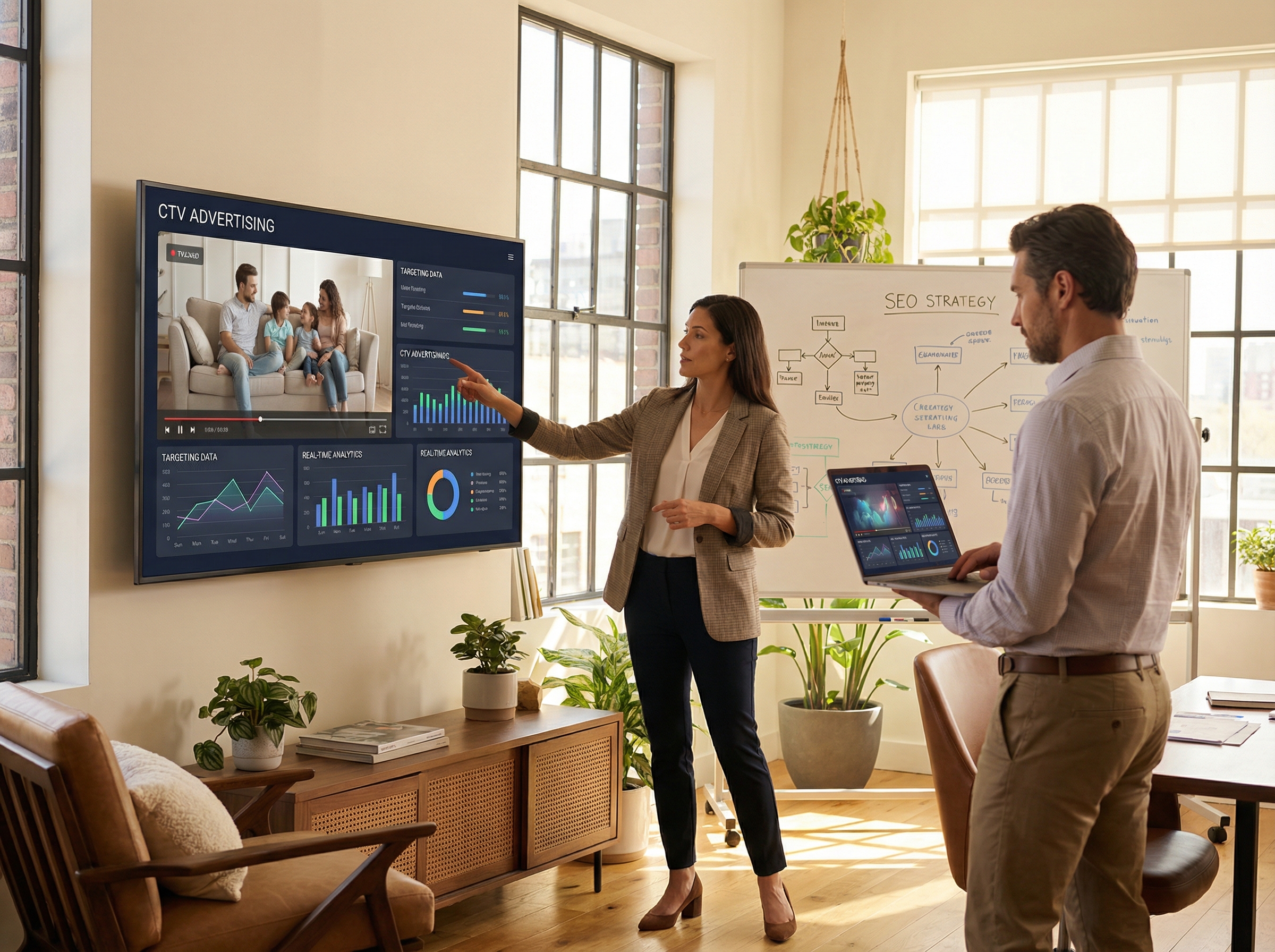
Connected TV advertising refers to video ads delivered through internet-connected television devices, including smart TVs, streaming devices like Roku and Amazon Fire TV, gaming consoles, and set-top boxes. Unlike traditional linear television that broadcasts to mass audiences at scheduled times, CTV allows advertisers to serve targeted video ads to specific households and viewers based on data-driven insights.
The term CTV is often used interchangeably with OTT (over-the-top) advertising, though there are technical distinctions. OTT refers to content delivered over the internet, bypassing traditional cable or satellite providers, while CTV specifically refers to the television device used to consume that content. For practical purposes, both terms describe the same advertising opportunity: reaching audiences through streaming content on television screens.
The CTV advertising market is experiencing explosive growth that shows no signs of slowing. Ad spending jumped 16% year-over-year in 2024, and projections indicate continued expansion to $42.4 billion by 2027. This growth is driven by fundamental shifts in viewer behavior, with cord-cutting accelerating and streaming becoming the dominant form of television consumption.
Programmatic CTV ad spend reached $27 billion in 2025, representing over 84% of total CTV spending. This programmatic dominance means that the majority of CTV advertising operates through automated buying platforms that enable sophisticated targeting, real-time bidding, and performance optimization. For performance marketers familiar with digital advertising platforms, this programmatic infrastructure provides a familiar foundation for campaign management.
Marketer adoption continues to accelerate, with 66% of marketers increasing their CTV budgets in 2025. This widespread investment reflects growing confidence in CTV's ability to deliver measurable business outcomes. Performance marketers are discovering that CTV bridges the gap between upper-funnel brand awareness and lower-funnel conversion goals, offering versatility across the entire marketing funnel.
The CTV ecosystem consists of multiple platform types, each offering distinct advantages. As of Q2 2025, Roku maintains market leadership with 37% market share in North America, followed by Amazon at 17%. Other significant platforms include Samsung TV Plus, LG Channels, Vizio, Apple TV, and gaming consoles like PlayStation and Xbox.
Beyond device platforms, advertisers can access inventory through ad-supported streaming services. Major players include Hulu, Peacock, Paramount+, Pluto TV, Tubi, and the recently launched ad-supported tiers from Netflix and Disney+. Each platform offers different audience demographics, content genres, and advertising formats, allowing you to strategically select placements that align with your target customer profile.
Programmatic advertising platforms serve as the gateway for most CTV campaigns. These demand-side platforms (DSPs) aggregate inventory from multiple CTV publishers and provide the targeting, bidding, and measurement capabilities essential for performance marketing. Understanding this ecosystem helps you make strategic decisions about where to allocate budget for maximum impact.
Successful CTV campaigns begin with clearly defined objectives that align with your broader marketing goals. While CTV excels at brand awareness and consideration, it increasingly drives direct response outcomes when implemented strategically. Your objectives should be specific, measurable, and tied to business metrics that matter to your organization.
For awareness objectives, CTV delivers impressive results, with campaigns generating an average 20% lift in brand awareness, 15% lift in brand consideration, and 10% lift in purchase intent. These upper-funnel metrics establish the foundation for downstream conversions and should be measured through brand lift studies or survey-based research.
For performance objectives, you'll focus on measurable actions like website visits, app downloads, lead form submissions, or purchases. CTV advertising ROI averages 4.5x higher than linear TV when campaigns are optimized for direct response. The key is implementing robust attribution methodologies that connect CTV exposures to conversion events across devices and channels.
CTV advertising offers sophisticated targeting capabilities that rival traditional digital channels. However, the shared-screen nature of television viewing requires a thoughtful approach. According to IAB best practices research, advertisers should start with broader audience criteria, focusing first on geography before layering in additional targeting parameters.
Demographic targeting allows you to reach households based on age, gender, income, education, household composition, and life stage. This foundational layer ensures your ads reach audiences with the basic characteristics of your target customer. Unlike traditional TV's reliance on program-based proxies for demographics, CTV uses actual household-level data for precise targeting.
Behavioral targeting leverages purchase history, content consumption patterns, and online browsing behavior to identify high-intent audiences. You can target households that have visited specific product categories, demonstrated interest in competitor offerings, or exhibited behaviors correlated with conversion likelihood. This approach mirrors the behavioral targeting you're already using in digital advertising channels.
Contextual targeting places your ads within content that aligns with your brand message or product category. Advertising athletic apparel during sports programming or financial services during business news creates natural alignment between content and commercial. Advanced contextual targeting uses AI to analyze video content at a granular level, identifying moments and themes most relevant to your message.
Retargeting and prospecting strategies bring your existing customer data into CTV campaigns. You can target households that have visited your website, abandoned shopping carts, or matched segments from your CRM system. Conversely, lookalike modeling identifies new households with characteristics similar to your best customers, expanding reach while maintaining targeting precision.
Budget planning for CTV requires understanding both the cost structure and the time needed to generate meaningful results. CTV CPMs (cost per thousand impressions) typically range from $20 to $50, depending on targeting parameters, platform selection, and competitive factors. While this may appear higher than some digital channels, the completion rates and engagement levels often justify the premium.
Most experts recommend running CTV campaigns for at least 4 weeks to gather sufficient data for optimization, with 8-12 weeks being optimal for most objectives. This duration allows you to build frequency, test creative variations, and refine targeting based on performance signals. Rush campaigns with insufficient flight time often underperform due to inadequate frequency and limited optimization opportunity.
An advertiser's CTV budget typically comprises 15-30% of their overall marketing budget, reflecting CTV's role as a significant but not exclusive channel. For performance marketers accustomed to testing new channels with minimal investment, starting with 10-15% allows you to validate CTV's effectiveness for your specific business before scaling aggressively.
Creative quality remains the single most important factor in CTV campaign performance. Even with perfect targeting and optimal budget allocation, weak creative limits your results. The good news is that CTV creative follows established video advertising principles while incorporating specific considerations for the television environment and viewer mindset.
Video length typically ranges from 15 to 30 seconds, with 30-second spots being the most common format. According to platform data, 30-second ads on CTV achieve completion rates up to 95.92%, demonstrating strong viewer attention. However, shorter 15-second formats work well for simpler messages or frequency-building campaigns where multiple exposures are planned.
The opening 3-5 seconds are critical for capturing attention and establishing your message. Unlike skippable video ads on other platforms, most CTV ads are non-skippable, but that doesn't mean viewers are actively engaged. Start with compelling visuals, clear branding, and an immediate value proposition that gives viewers a reason to pay attention.
Effective calls-to-action bridge the gap between passive viewing and active engagement. Since viewers are sitting on their couches rather than at computers with keyboards ready, your CTA must account for the unique response environment of television advertising.
Best practices include displaying your website URL or call-to-action on screen throughout the ad, speaking the action out loud during the video, and incorporating QR codes that allow viewers to scan with their mobile devices. This multi-modal approach accommodates different viewer preferences and makes it as easy as possible to take the desired action.
URL simplification is essential for CTV advertising. Complicated URLs with multiple subdirectories or parameters are difficult to remember and type. Create a simple, memorable vanity URL specifically for your CTV campaign, or use trackable short links that redirect to your landing page. This also enables campaign-specific attribution when analyzing traffic sources.
Systematic creative testing drives continuous improvement in CTV campaign performance. AI-powered creative optimization enables you to test multiple variations efficiently, identifying the specific elements that drive the strongest response from your target audience.
Variables to test include opening hooks, value proposition messaging, visual styles, voiceover approaches, music selections, and call-to-action framing. Start with high-impact variables like opening hooks and core messaging before optimizing secondary elements. Even small improvements in creative performance compound across thousands of impressions to generate significant lift in overall campaign results.
Apply learnings from your YouTube video advertising campaigns to inform your CTV creative strategy. Many creative principles translate across platforms, though the viewing environment and audience mindset differ. Cross-channel learning accelerates your optimization and prevents you from starting from scratch with each new platform.
Measurement represents both the greatest opportunity and the most significant challenge in CTV advertising. Unlike linear television's reliance on panels and surveys to estimate viewership, CTV advertising leverages real-time data collection that tracks individual household and device-level interactions. However, connecting these impressions to downstream business outcomes requires sophisticated attribution methodologies.
According to research, the primary issue with CTV isn't cost but poor measurement, with many marketers struggling to connect CTV campaigns to business outcomes while relying on outdated metrics like reach and frequency. For performance marketers accustomed to granular conversion tracking, this measurement gap can be frustrating. The solution lies in implementing robust attribution frameworks specifically designed for CTV's unique characteristics.
The IAB's Advanced TV Attribution guide outlines several methodologies for measuring CTV campaign impact. Each approach offers different levels of sophistication, accuracy, and implementation complexity.

Pixel-based tracking implements conversion pixels on your website or app to detect when users exposed to CTV ads subsequently convert. This method works well for direct response campaigns but requires cross-device matching to connect television exposures with mobile or desktop conversions. Identity resolution partners facilitate this matching using probabilistic and deterministic methods.
ACR (Automatic Content Recognition) technology tracks linear and streaming ads based on audio or visual content playing on smart TV screens. This enables brands to connect TV ad exposures with conversion events like search traffic lifts, app downloads, or website visits with significantly more confidence than traditional methods. Major smart TV manufacturers including Samsung, LG, and Vizio provide ACR data to attribution providers.
Multi-touch attribution distributes conversion credit across all touchpoints in the customer journey, including CTV exposures. This approach proves especially valuable for campaigns where viewers see multiple ads across different platforms before taking action. By crediting CTV for its role in the conversion path rather than requiring it to be the last touch, you gain a more accurate picture of its contribution to business outcomes.
Incrementality testing uses control and exposed groups to measure the true lift generated by CTV advertising. By comparing conversion rates between households exposed to your ads and matched control groups that weren't exposed, you can isolate CTV's incremental impact. This gold-standard approach requires sufficient scale but provides the most defensible ROI calculations.
Effective CTV measurement requires tracking metrics across awareness, consideration, and conversion stages. Comprehensive cross-channel measurement ensures you understand CTV's full contribution to your marketing ecosystem.
Reach and frequency metrics indicate how many unique households saw your ads and how often. While these traditional metrics don't directly measure outcomes, they provide essential context for campaign delivery. Target frequency typically ranges from 3-5 exposures per household, balancing awareness building with budget efficiency.
Completion rate measures the percentage of viewers who watched your entire video ad. The 90-98% completion rates typical for CTV ads far exceed most digital video platforms, indicating strong attention and engagement. Declining completion rates may signal creative fatigue or relevance issues requiring optimization.
Website traffic lift compares site visits during and after CTV flights to baseline periods. Segment this analysis by new versus returning visitors and by traffic source to understand how CTV drives direct visits, branded search, and discovery through other channels. Time-lag analysis reveals how long after exposure viewers typically convert.
Conversion metrics including leads, trials, purchases, and revenue represent the ultimate measure of campaign success. Attribution windows typically range from 7-30 days post-exposure, reflecting the consideration cycle for your specific product or service. Calculate CPA (cost per acquisition) and ROAS (return on ad spend) to evaluate efficiency against other channels and business benchmarks.
Brand lift studies measure changes in awareness, consideration, favorability, and purchase intent among exposed audiences. While requiring additional investment in research partnerships, brand lift provides crucial insights into upper-funnel impact that may not be captured through conversion tracking alone.
Programmatic technology powers the vast majority of CTV advertising, enabling the automated buying, targeting, and optimization that performance marketers require. The IAB Tech Lab's CTV Programmatic Guide provides comprehensive technical documentation for the ecosystem, covering standards, protocols, and best practices.
The programmatic supply chain connects advertisers with CTV inventory through a series of technology platforms. Demand-side platforms (DSPs) provide advertiser interfaces for campaign management and bidding. Supply-side platforms (SSPs) aggregate inventory from publishers and streaming services. Ad exchanges facilitate real-time bidding between DSPs and SSPs, with impressions awarded to the highest bidder in milliseconds.
OpenRTB protocols standardize the communication between platforms, ensuring interoperability and efficient transactions. The IAB Tech Lab's recent updates include enhanced support for CTV-specific ad formats including pause ads, menu ads, screensaver ads, and overlay formats that extend beyond traditional video pre-roll.
Programmatic CTV unlocks sophisticated targeting through first-party, second-party, and third-party data integration. First-party data from your CRM, website visitors, and customer files can be onboarded to CTV platforms for targeting and suppression. This ensures you're reaching prospects rather than existing customers (unless running retention campaigns) and enables personalized messaging based on customer lifecycle stage.
Second-party data partnerships with complementary brands or publishers provide access to audiences with relevant attributes. Third-party data segments from providers like Experian, Acxiom, and Oracle offer extensive demographic, behavioral, and interest-based targeting options. Layer multiple data sources to create precise audience definitions that balance scale with specificity.
AI-powered contextual targeting analyzes video content in real-time to identify optimal placement opportunities. Advanced systems can detect objects, scenes, emotions, activities, and themes within programming, enabling you to align your ads with contextually relevant moments. This addresses privacy concerns while maintaining targeting precision as the industry moves away from cookie-based tracking.
Bidding optimization balances cost efficiency with campaign delivery. Most programmatic CTV campaigns use CPM (cost per thousand impressions) bidding, though some platforms now offer CPA (cost per acquisition) and other performance-based models. Start with competitive CPM bids to ensure delivery, then optimize downward as you identify high-performing inventory sources and audience segments.
Daypart optimization allocates budget to the viewing times that generate the strongest performance. CTV viewing peaks during evening prime-time hours but extends throughout the day as streaming replaces linear TV. Analyze conversion patterns by hour and day of week, shifting budget toward periods that drive the highest return.
Inventory optimization identifies the specific apps, publishers, and content categories delivering the best results. Most DSPs provide reporting by inventory source, enabling you to create inclusion and exclusion lists that focus spending on proven performers. Regular review and optimization of these lists prevents budget waste on underperforming inventory.
Frequency capping prevents oversaturation by limiting how many times the same household sees your ads. While some repetition builds memory and response, excessive frequency creates diminishing returns and wasted impressions. Most campaigns target 3-5 exposures per household per week, though optimal frequency varies by product category, creative quality, and campaign objectives.
CTV delivers maximum value when integrated into a comprehensive multi-channel strategy rather than operating in isolation. The awareness and consideration generated by CTV ads amplify the performance of your search, social, and display campaigns. Conversely, retargeting CTV viewers through other channels improves conversion rates and accelerates the buyer journey.
Sequential messaging coordinates creative across channels to tell a cohesive brand story. Use CTV to introduce your brand and value proposition, then retarget exposed households with product-specific messages through display, social, and video channels. This approach builds recognition and trust while moving prospects through the funnel with relevant messaging at each stage.
Search integration captures the intent generated by CTV advertising. Allocate additional search budget during CTV flights to ensure you capture branded and category searches from viewers who saw your ads. Analyze search query volume and patterns to understand how CTV influences search behavior, informing both your CTV creative and search keyword strategy.
Performance marketers excel at data-driven budget reallocation, shifting resources toward channels and tactics delivering the strongest returns. CTV should be evaluated using the same rigorous standards you apply to all marketing investments. Compare CTV's contribution to business goals against alternative channels, reallocating budget to maximize overall portfolio performance.
Implement a systematic testing framework that evaluates CTV against other video channels and upper-funnel tactics. Run controlled experiments with defined success metrics, sufficient budgets, and appropriate measurement methodologies. Use these tests to build confidence in CTV's effectiveness for your specific business before committing major budget shifts.
Seasonality planning aligns CTV investments with demand cycles and business priorities. Increase CTV spending during peak seasons when demand is elevated and competition for attention intensifies. Use CTV's brand-building capabilities to prepare the market for new product launches, sales events, or category expansion initiatives.
Platform selection depends on your budget, internal capabilities, and campaign objectives. Self-service DSPs provide direct access to programmatic inventory with full control over targeting, bidding, and optimization. These platforms work well for experienced performance marketers with video advertising expertise and sufficient scale to justify the learning curve.
Managed service providers offer end-to-end campaign execution including strategy, creative production, media buying, and optimization. This approach reduces internal resource requirements and leverages partner expertise, making it attractive for first-time CTV advertisers or those lacking in-house video capabilities. Evaluate partners based on category experience, technology stack, and measurement capabilities.
Working with an experienced digital marketing agency that specializes in integrated campaigns can accelerate your CTV success. At OmniFunnel Marketing, we blend AI-powered optimization with comprehensive multi-channel strategies to deliver exceptional results for our clients. Our proprietary DeepML Technology enables sophisticated targeting and bid optimization that maximizes CTV performance while maintaining cost efficiency.
Use this checklist to ensure you've addressed all critical elements before launching your CTV campaign:
Once you've validated CTV's effectiveness through initial campaigns, systematic scaling maximizes your opportunity. Expand audience targeting to reach additional segments while maintaining performance standards. Test new creative approaches to prevent fatigue and identify messaging that resonates with different audience cohorts.
Geographic expansion extends successful campaigns to new markets. Start with markets similar to your proven geographies in terms of demographics, competitive dynamics, and business infrastructure. Use learnings from initial markets to refine targeting and creative for expansion markets, avoiding the assumption that one-size-fits-all approaches will work everywhere.
Platform expansion diversifies your CTV presence across multiple streaming services and device types. While starting focused on one or two platforms makes sense for testing, mature CTV programs leverage multiple platforms to maximize reach and frequency. Each platform offers unique audience characteristics and inventory opportunities worth exploring as you scale.
Connected TV advertising represents a fundamental shift in how performance marketers can leverage the power of television. The combination of massive reach, engaged audiences, sophisticated targeting capabilities, and robust measurement creates an opportunity to drive both brand-building and direct response outcomes at scale. With CTV adoption accelerating and programmatic infrastructure maturing, the time to develop expertise and capture market share is now.
Success in CTV advertising requires applying performance marketing principles to the television environment. This means rigorous testing, data-driven optimization, comprehensive measurement, and relentless focus on business outcomes. It also requires patience to allow campaigns sufficient time to generate results and sophistication to implement attribution methodologies that capture CTV's full contribution to your marketing ecosystem.
The performance marketers who master CTV advertising will gain a significant competitive advantage. They'll reach audiences migrating away from traditional media channels, build brands that stand out in crowded markets, and drive measurable business growth through a channel that combines the emotional power of video with the precision of digital advertising. Whether you're just beginning to explore CTV or looking to optimize existing campaigns, the strategies outlined in this guide provide a roadmap for success in the rapidly evolving world of streaming television advertising.

As a beacon of innovation, we guide your business through the evolving digital landscape with cutting-edge solutions.

Our steadfast reliability anchors your strategic endeavors, ensuring consistent delivery and performance.

We harness state-of-the-art technology to provide smart, scalable solutions for your digital challenges.

Our extensive experience in the digital domain translates into a rich tapestry of success for your brand.

Upholding the highest standards of digital security, we protect your business interests with unwavering vigilance.

We offer a stable platform in the tumultuous digital market, ensuring your brand's enduring presence and growth.
OmniFunnel Marketing has garnered notable recognition from a range of prestigious media outlets. This acknowledgment from leading publications not only underscores our expertise in the digital marketing realm but also highlights our commitment to delivering exceptional marketing strategies. Our presence in these prominent media sources is a testament to the trust and value we bring to our clients, elevating their marketing efforts to new heights.





As a beacon of innovation, we guide your business through the evolving digital landscape with cutting-edge solutions.
Our steadfast reliability anchors your strategic endeavors, ensuring consistent delivery and performance.
We harness state-of-the-art technology to provide smart, scalable solutions for your digital challenges.
Our extensive experience in the digital domain translates into a rich tapestry of success for your brand.
Upholding the highest standards of digital security, we protect your business interests with unwavering vigilance.
We offer a stable platform in the tumultuous digital market, ensuring your brand's enduring presence and growth.

Experienced Senior Teams
Profit-First Strategy & Consulting
Channel-Specific Paid Media
Tracking & Attribution Specialists
Conversion Rate Optimization (CRO)
In-House Developers
In-House Creative Production
Proprietary First-Party Data Priming
Full-Funnel Feedback Loops
AI Voice Agents & Automated
AI Content Engine
MCP + LLM Real-Time Optimization
Value-Based Bidding & ROI
Installed CMO Leadership
You Own All Assets






Our talented team brings 20+ years of expertise and passion.

Michael Tate, CEO and Co-Founder of OmniFunnel Marketing, is a pioneering leader in leveraging AI and machine learning (ML) technologies to revolutionize digital marketing. With over 20 years of expertise in new media sales, Michael has distinguished himself as an SEO/SEM specialist, adept at integrating AI-driven strategies to enhance paid performance marketing. Since January 2016, he has been instrumental in transforming OmniFunnel Marketing into a hub of innovation, particularly in the legal and medical sectors. His philosophy, “more visibility without more expenditure,” is brought to life through AI-powered marketing tools, offering small and medium-sized firms a competitive edge.
His role involves not just client engagement but also orchestrating AI and ML tools to optimize marketing strategies for ROI maximization. Michael's expertise in AI-driven data analysis and workflow automation enables businesses to achieve unprecedented productivity and efficiency, ensuring robust online presence and profitability.
.webp)
Former foreign policy advisor turned digital marketing and communications consultant, Kalinda's extensive professional journey spans nearly two decades across both public and private sectors. Her expertise lies in strategic and creative marketing strategy, as well as communications management for businesses, associations, and government agencies. Having lived and worked globally, she has had the privilege of assisting businesses—both in the US and abroad—achieve their goals through impactful social media campaigns, community building, outreach, brand recognition, press relations, and corporate communication.
Kalinda's passion lies in cultivating meaningful relationships among stakeholders while building lasting digital brands. Her signature approach involves delving into each client’s unique needs and objectives from the outset, providing highly customized, bespoke service based on their needs. From political leaders to multi-unit restaurant concepts and multi-million dollar brands, Kalinda has successfully guided a diverse range of clients reach and exceed their digital marketing, public relations, and sales goals.

OmniFunnel Marketing's Director of Search Marketing, brings close to 15 years of digital marketing experience to leading the agency's paid media strategy. A dedicated Google Ads specialist at his core, Juan's command extends across Meta, TikTok, and Amazon, with a primary focus on ecommerce and an equally sharp discipline in lead generation. He has built and scaled campaigns across virtually every vertical, from local service businesses to national, multi-market accounts, and his leadership has been central to establishing paid media as one of OmniFunnel's most consistent growth engines.
What separates Juan's work is the conviction that campaigns are only as good as the signal beneath them. Before a dollar scales, he pressure tests the full measurement layer, tracking architecture, event design, and the quality of the conversion data flowing back to each platform, and he operates daily inside attribution platforms like Triple Whale and Northbeam, reconciling what Meta, Google, TikTok, and Amazon each claim against what the business actually banked. That foundation powers the fundamentals that move results: precise account structure, disciplined budget management, and relentless, data-driven testing and optimization, increasingly paired with AI-powered tools to sharpen targeting and surface insights faster. The combination lets OmniFunnel Marketing scale client accounts sustainably, growing spend and revenue in tandem while delivering measurable, lasting business growth.

Camila is a pioneering digital marketing leader who began shaping influencer strategy before it became an industry standard, partnering with mega brands like H&M, Universal Music, FabFitFun, FoxyBae, and Amika to name a few. An early adopter and entrepreneur, she evolved from affiliate manager to blogger to 7-figure ecommerce brand founder, and later accelerated growth for an innovative Silicon Valley software startup redefining personal health data ownership and user empowerment. Along the way, she played a pivotal role in educating leading global agencies, including Starcom, Ogilvy, and Universal McCann, on the power of influencer marketing in its formative years.
At OmniFunnel Marketing, Camila leads creative across every major social platform, Meta, Instagram, TikTok, YouTube, and beyond, carrying concepts from insight through finished production, often in front of the camera herself. She owns the full customer lifecycle as well, with expert command of email and SMS automation inside platforms like Klaviyo, building the flows, segmentation, and campaigns that turn first purchases into durable repeat revenue. With deep expertise in customer acquisition, scalable strategy, and trend forecasting, Camila bridges the gap between people and brands, aligning KPIs with market realities while delivering measurable growth. She remains at the forefront of digital innovation, integrating the power of AI with human insight to fuel growth, relevance, and long-term brand value.

Emma Harris, Chief Operating Officer (COO) of OmniFunnel Marketing, Emma plays a pivotal role in steering the operational direction and strategy of the agency. Her responsibilities are multi-faceted, encompassing various aspects of the agency's operations.
Emma utilizes her extensive operational experience to lead and oversee the agency's day-to-day operations. She is responsible for developing and implementing operational strategies that align with the agency's long-term goals and objectives. Her strategic mindset enables her to foresee market trends and adapt operational strategies accordingly, ensuring the agency remains agile and competitive.

Joseph Pagan, OmniFunnel Marketing's Director of Design & Development, is a visionary in integrating AI and ML into creative design and web development. His belief in the synergy of UI/UX, coding, and AI technologies has been pivotal in advancing OmniFunnel's design and development frontiers. Joseph has led his department in leveraging AI and workflow automation to create websites that are not only aesthetically pleasing but highly functional and intuitive
His approach involves using advanced AI tools to streamline web development processes, ensuring adherence to top-notch coding standards and design guidelines. This leads to enhanced efficiency, accuracy, and client satisfaction. Joseph's extensive experience across different design and development domains, combined with his proficiency in AI and ML, empowers OmniFunnel Marketing to deliver cutting-edge, user-centric digital solutions that drive business growth and customer engagement.

Sarah Martinez, as the Marketing Manager at OmniFunnel Marketing, holds a crucial role in shaping and executing the marketing strategies of the agency. Her responsibilities are diverse and impactful, directly influencing the brand's growth and presence in the market.
Sarah is responsible for crafting and overseeing the execution of marketing campaigns. This involves understanding the agency's objectives, identifying target audiences, and developing strategies that effectively communicate the brand's message. She ensures that each campaign is innovative, aligns with the agency's goals, and resonates with the intended audience.
Discover Success Stories from OmniFunnel's Diverse Portfolio.
Dive into the narratives of our clients who have embraced OmniFunnel's AI-driven marketing solutions to monumental success. Their experiences underscore our commitment to harnessing artificial intelligence for strategic marketing that not only reaches but resonates with target audiences, fostering robust engagement and exceptional growth.
Kevin Stranahan
Jane Martinez
David Butler
Discover Success Stories from OmniFunnel's Diverse Portfolio.
Dive into the narratives of our clients who have embraced OmniFunnel's AI-driven marketing solutions to monumental success. Their experiences underscore our commitment to harnessing artificial intelligence for strategic marketing that not only reaches but resonates with target audiences, fostering robust engagement and exceptional growth.
"OFM's expertise in eCommerce marketing is unparalleled. They optimized our PPC campaigns, revamping our ad spend to yield an astounding ROI. If you're looking to make waves in the digital world, look no further than OFM."
Kevin Stranahan
"Transparency and innovation are at the core of OFM’s services. Their monthly reports are comprehensive, and their readiness to adapt and innovate is remarkable. We've finally found a digital marketing agency we can trust for the long haul."
Jane Martinez
"OmniFunnel's AI solutions have exceeded our expectations and delivered outstanding results."
David Butler
Discover Success Stories from OmniFunnel's Diverse Portfolio.
Dive into the narratives of our clients who have embraced OmniFunnel's AI-driven marketing solutions to monumental success. Their experiences underscore our commitment to harnessing artificial intelligence for strategic marketing that not only reaches but resonates with target audiences, fostering robust engagement and exceptional growth.
"OFM's expertise in eCommerce marketing is unparalleled. They optimized our PPC campaigns, revamping our ad spend to yield an astounding ROI. If you're looking to make waves in the digital world, look no further than OFM."
Kevin Stranahan
"Transparency and innovation are at the core of OFM’s services. Their monthly reports are comprehensive, and their readiness to adapt and innovate is remarkable. We've finally found a digital marketing agency we can trust for the long haul."
Jane Martinez
"OmniFunnel's AI solutions have exceeded our expectations and delivered outstanding results."
David Butler
At OmniFunnel Marketing, we pride ourselves on being a beacon of innovation and excellence in the digital marketing world. As an award-winning agency, we are celebrated for our pioneering strategies and creative ingenuity across the digital landscape. Our expertise is not confined to a single aspect of digital marketing; rather, it encompasses a full spectrum of services, from SEO and PPC to social media and content marketing. Each campaign we undertake is an opportunity to demonstrate our skill in driving transformative results, making us a trusted partner for businesses seeking to navigate and excel in the complex digital arena. Our holistic approach ensures that every facet of digital marketing is leveraged to elevate your brand, engage your audience, and achieve outstanding growth and success


.webp)








Ready to level up your online game? Call (844) 200-6112 or dive into the form below.