















Get In Touch
Contact Us Today for a
Comprehensive Analysis and Strategy Session.
Ready to level up your online game? Call (844) 200-6112 or dive into the form below.
Embrace the future of collaboration with OmniFunnel's Oculus 2 VR headset offer for valued clients. It's your entry into immersive VR meetings in the metaverse, redefining digital meetings and shaping virtual collaboration in the realm of web3.
Franchise businesses face a unique marketing paradox: maintaining consistent brand messaging across dozens or hundreds of locations while adapting campaigns to meet local market demands. According to research from BrightLocal, 45% of multi-location brands now use a hybrid approach combining centralized marketing teams with location-level local marketing, recognizing that neither purely centralized nor completely decentralized strategies work effectively at scale. This balancing act creates operational complexity that drains resources, produces inconsistent results, and leaves franchisees struggling to compete in their local markets.
Marketing automation has emerged as the definitive solution to this challenge. The global marketing automation market is projected to grow from 5.65 billion dollars in 2024 to 14.55 billion dollars by 2031, driven largely by multi-location businesses seeking efficiency and scalability. For franchise organizations specifically, automated drip sequences have been shown to shorten sales cycles by 29%, while companies using marketing automation see a 10% or greater boost in revenue within 6-9 months due to improved lead management. These results explain why franchise marketing automation has become essential infrastructure rather than optional technology.
This comprehensive guide explores how franchise organizations can implement marketing automation to scale local campaigns effectively across multiple locations. You will learn practical strategies for maintaining brand consistency while empowering local customization, discover the technology platforms that support distributed marketing operations, and understand how to avoid common pitfalls that undermine automation investments. Whether you operate 5 locations or 500, the frameworks outlined here will help you build marketing systems that drive sustainable growth across your entire franchise network.

Franchise marketing automation refers to software platforms and workflows that enable franchise organizations to execute, manage, and measure marketing campaigns across multiple locations from centralized systems while allowing location-specific customization. Unlike traditional marketing automation designed for single-location businesses, franchise-specific solutions address the unique challenges of distributed networks including brand governance, local market adaptation, franchisee enablement, and performance tracking across territories.
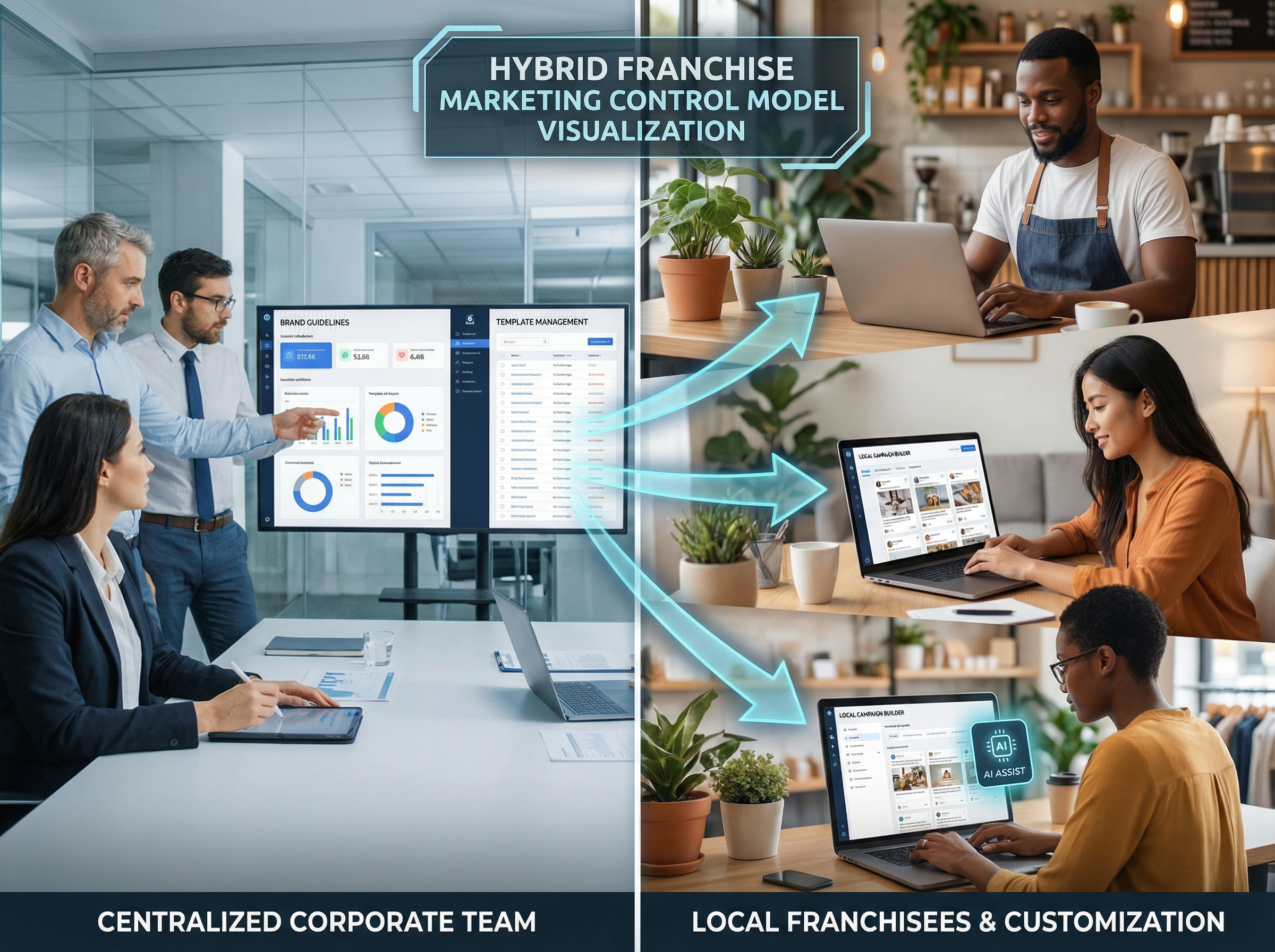
The foundation of effective franchise marketing automation is centralized brand control combined with local execution flexibility. Modern platforms provide corporate marketing teams with master templates, approved messaging frameworks, and brand asset libraries that ensure consistency. Franchisees then access these resources through intuitive interfaces where they can customize specific elements such as local offers, geographic targeting parameters, contact information, and location-specific imagery while remaining within brand guidelines. This architecture prevents brand dilution while eliminating the bottleneck of requiring corporate approval for every local marketing initiative.
Distributed marketing automation enables brands to engage franchisees in contextualized content creation and distribution without diluting brand voice. According to industry research, 98% of multi-location brands now use technology to support local strategies, with distributed marketing offering centrally located repositories of marketing materials that franchisees can co-brand and customize for their particular markets. This empowers franchisees with customizable, relevant, and version-optimized marketing assets while corporate maintains control over customization levels and access to establish brand conformity and legal compliance.
Advanced automation workflows use data triggers to activate campaigns automatically based on specific conditions. For example, when a new franchisee location opens, the system can automatically initiate a grand opening campaign sequence including pre-launch social media posts, email announcements to local prospect lists, paid search campaigns targeting the surrounding area, and follow-up nurture sequences for initial leads. Similarly, seasonal promotions can be scheduled to activate across all locations simultaneously while incorporating location-specific elements like local weather patterns, regional events, or demographic preferences.
The financial returns from marketing automation are substantial and well-documented. Companies make an average of 5.44 dollars for every 1 dollar spent on marketing automation, translating to a 544% ROI. For franchise organizations, this multiplies across every location in the network. When a franchise with 50 locations implements effective automation, the aggregate ROI improvement can transform overall profitability. Furthermore, 76% of companies see ROI from marketing automation within the first year, making it one of the fastest-returning technology investments available to franchise organizations.
Beyond direct financial returns, automation delivers operational efficiency that scales exponentially with network size. Manual campaign execution across multiple locations requires duplicated effort at each franchisee, creating inconsistent quality, delayed launches, and significant labor costs. Automation eliminates this duplication by creating reusable workflows that execute consistently across the entire network. A corporate marketing team of three people using automation can effectively manage campaigns for hundreds of locations, whereas the same team managing manual campaigns might struggle with even a dozen locations. This efficiency allows franchise organizations to grow their location count without proportionally increasing marketing staff.
Marketing automation significantly improves lead generation and conversion rates. Approximately 80% of marketers using automation report an increase in leads, while 77% of businesses see higher conversion rates. For franchises, automation ensures that every location follows proven nurture sequences rather than allowing leads to fall through the cracks due to inconsistent follow-up. Automated lead scoring identifies the highest-value prospects and routes them to the appropriate location automatically, ensuring optimal response times and customer experiences regardless of which territory a prospect originates from.
Successfully scaling local campaigns across franchise networks requires a strategic framework that addresses both centralized governance and local customization. The following framework has been proven across thousands of franchise locations and provides a systematic approach to implementation.
Consistency builds trust across multiple locations. When customers interact with your franchise through any channel or location, they expect a cohesive, on-brand experience. Research shows that campaigns featuring consistent brand messaging and testimonials boost conversions by 33%. Your first step is creating comprehensive brand guidelines that define approved messaging frameworks, visual identity standards, tone of voice parameters, and compliance requirements. These guidelines should be specific enough to ensure consistency but flexible enough to allow meaningful local customization.
Create a centralized digital asset library containing all approved marketing materials including logos, images, video content, email templates, social media graphics, ad copy variations, and campaign frameworks. Modern franchise marketing platforms provide permission-based access systems where different franchisees can access different asset collections based on their region, tier level, or specific permissions. This ensures that every message and asset used by your network is on-brand and professionally aligned with corporate standards while making it easy for franchisees to find and deploy the materials they need. Learn more about implementing these systems in our guide to AI Business Process & Marketing Automation.
Franchise brands typically choose from three operational models: centralized ad accounts where all campaigns run from one business account, decentralized accounts where each franchisee runs ads independently, or hybrid structures with centralized control over brand assets and budgets combined with franchisee-level access to localized targeting. Industry experts consistently recommend the hybrid model as it allows brand consistency while empowering franchisees to advertise effectively in their markets.
In a hybrid model, corporate marketing establishes master campaigns with approved messaging, creative assets, and targeting parameters. Franchisees can then activate these campaigns for their specific territories, adjusting elements like geographic radius, budget allocation, local offers, and schedule timing. The system enforces guardrails preventing off-brand messaging or unauthorized changes while giving franchisees the autonomy they need to respond to local market conditions. This approach has been shown to deliver superior results compared to purely centralized or decentralized models because it combines the consistency and expertise of corporate marketing with the market knowledge and responsiveness of local franchisees.
Not all franchise locations operate in identical markets. Customer demographics, competitive landscapes, seasonal patterns, and economic conditions vary significantly across territories. Effective franchise marketing automation requires research for each target region to understand how customer behavior differs from place to place. Once you have completed this research, create customer segments specific to each region that inform how automated campaigns should be customized.
Government demographic and economic data expose income distributions and population growth patterns. Google Trends analysis reveals regional search behavior and seasonal interest patterns. Local chambers of commerce provide context on economic conditions and competitive landscapes. Stakeholder interviews with location managers surface qualitative insights that quantitative data misses. Combining these data sources creates comprehensive market profiles for each territory that inform automation rules. For example, a franchise location in a college town might automatically emphasize student discounts and activate back-to-school campaigns, while a location in a retirement community emphasizes different messaging and offers entirely.
Geo-targeting is the foundation of franchise advertising effectiveness. Without proper geographic parameters, campaigns float into the void or worse, create internal competition where one location's ads compete with another. Best practices for multi-location geo-targeting include setting 3-10 mile radius targeting around each storefront, using radius targeting instead of zip codes to minimize internal competition, and implementing location-based exclusions to prevent audience cannibalization between nearby franchises.
Modern automation platforms can automatically generate and manage geo-targeted campaigns across hundreds of locations simultaneously. You define the targeting parameters once at the template level such as 5-mile radius, exclusion of competitor franchise territories, and demographic filters, then the system applies these rules to every location. When you add a new franchise location, the automation platform automatically creates the geo-targeted campaign architecture for that territory, ensuring immediate market coverage without manual configuration. This approach eliminates the single biggest risk in multi-location marketing: your own locations competing against each other and eroding overall ROI.
The true power of franchise marketing automation emerges when you move beyond scheduled campaigns to triggered workflows that activate automatically based on specific conditions. These workflows ensure consistent, timely responses to marketing opportunities across every location without requiring manual intervention. Common franchise automation workflows include new location launch sequences, seasonal promotion activation, lead nurture campaigns, customer reactivation programs, review request automation, and local event marketing.
Consider a new location launch workflow. When corporate adds a new franchise location to the system, the automation platform detects this trigger and automatically initiates a 90-day launch sequence. Week one activates pre-launch social media teasers and begins building email lists through lead magnets. Week two launches grand opening paid advertising across search, social, and display channels with geo-targeting around the new location. Week three sends grand opening email announcements to the collected prospect list. Subsequent weeks continue with nurture sequences for unconverted leads, review solicitation from initial customers, and ongoing local awareness campaigns. This entire sequence executes automatically, ensuring every new location launches with professional marketing support regardless of franchisee marketing expertise.
Selecting the right technology platform is critical for franchise marketing automation success. The platform must balance centralized control with distributed execution, provide intuitive interfaces for franchisees with varying technical skills, integrate with existing business systems, and scale cost-effectively as your franchise network grows. Understanding the available options and their respective strengths helps you make informed decisions aligned with your specific requirements.
While general-purpose marketing automation tools like HubSpot or Mailchimp offer powerful capabilities, franchise-specific platforms provide features designed explicitly for multi-location operations. These specialized platforms understand the unique requirements of franchise marketing including franchisee portals, corporate approval workflows, location-based campaign management, aggregated and location-specific reporting, and compliance management for franchise disclosure and advertising regulations.
Leading franchise marketing platforms include systems that integrate SEO, social media, performance marketing, and content management from a single cloud-based interface while empowering local management. These platforms provide supporting operational documentation and videos for franchise operational manuals, making onboarding and training more efficient. Other popular options offer user-friendly interfaces that make it easy for franchisees to launch and manage complex marketing programs without extensive technical expertise, with programs that activate behind the scenes based on data triggers. When evaluating platforms, prioritize those offering customizable workflows tailored to your brand's unique needs, as discussed in our article on Best Practices for CRM + Automation Platform Integration.
Your franchise marketing automation platform must integrate seamlessly with your customer relationship management system to ensure lead data flows properly between marketing and sales functions. When a lead is generated through automated marketing campaigns, that information should automatically populate in the appropriate franchisee's CRM with complete attribution data showing which campaign, channel, and creative generated the lead. This integration enables accurate ROI measurement and ensures no leads fall through the cracks during handoff from marketing to sales operations.
Beyond CRM, effective franchise marketing automation requires integrations with advertising platforms including Google Ads, Facebook Ads, and other paid media channels, email service providers for message delivery and list management, social media management tools for coordinated posting across locations, analytics platforms for comprehensive performance tracking, and local business listing services to maintain consistent NAP citations across directories. The best franchise platforms provide pre-built integrations with these commonly used tools, reducing implementation complexity and ongoing maintenance requirements.
Franchise marketing automation creates massive amounts of data across numerous locations, campaigns, and channels. Your platform must provide reporting at multiple levels: corporate-level dashboards showing aggregate performance across all locations and identifying top and bottom performers, regional or territory-level reporting for franchise development teams or regional managers, and individual location dashboards giving franchisees visibility into their specific market performance. This multi-level reporting architecture ensures that everyone has access to the data they need for decision-making without overwhelming users with irrelevant information.
Establish clear key performance indicators that the automation platform tracks consistently across all locations. Common franchise marketing KPIs include cost per lead by location and channel, lead-to-customer conversion rate, customer acquisition cost, revenue per marketing dollar, local search visibility and ranking, online review quantity and rating, and campaign engagement metrics. By tracking these KPIs consistently through automated systems, you can quickly identify which locations are performing well, which need support, and which marketing strategies are most effective across your network. This data-driven approach enables continuous optimization of your franchise marketing automation systems.
Google has reported a 150% increase in local searches over recent years, and with the majority of consumers researching online before buying, local SEO has become essential for franchise success. Research shows that 51% of people check reviews before visiting local businesses, and positive reviews improve local search results while giving potential customers confidence in choosing your business. For multi-location franchises, local SEO presents both an enormous opportunity and a significant operational challenge. Automation provides the solution by enabling consistent local SEO execution across hundreds of locations without proportionally increasing workload.
Every franchise location needs a dedicated location page optimized for local search queries. These pages should include consistent elements like the complete business name, address, and phone number in consistent format, embedded Google Maps showing the location, business hours including holiday schedules, location-specific service descriptions, local team member profiles or bios, customer reviews and testimonials, and location-specific content addressing local market characteristics. Creating and maintaining these pages manually across hundreds of locations is impractical, but automation makes it manageable.
Modern franchise SEO platforms can automatically generate location pages using templates combined with location-specific data from your franchise management system. When you add a new location, the system automatically creates an optimized location page following your template specifications while populating location-specific information. The platform can also monitor these pages for optimization opportunities and alert you to issues like missing information, outdated content, or technical SEO problems. This ensures every location maintains strong local search presence without requiring individual attention. For comprehensive strategies, review our guide on Boosting Your Business Profile: Mastering Local SEO Strategies.
Google Business Profiles are critical for local search visibility, appearing in local pack results, Google Maps, and providing essential business information to potential customers. Managing these profiles across hundreds of franchise locations presents significant challenges including maintaining accurate and consistent information, responding to customer reviews promptly, posting regular updates and offers, adding location-specific photos, and monitoring for unauthorized edits or duplicate listings. Automation platforms designed for franchise operations can manage all these tasks at scale.
Franchise-focused local SEO tools provide centralized management of Google Business Profiles across all locations. Corporate can push updates to business information, hours, or services across the entire network simultaneously while allowing individual locations to add location-specific posts, photos, and responses. Automated review monitoring notifies franchisees immediately when new reviews appear, with templates for responses that maintain brand voice while addressing specific feedback. Some advanced platforms even use AI to suggest or generate review responses that franchisees can approve and post with one click. This combination of centralized control and local customization ensures consistent, high-quality Google Business Profile management that drives local search visibility and conversions.
Effective franchise SEO requires targeting location-specific keywords rather than generic national terms. For example, if you sell pizzas in New York City, using keywords such as best pizza in Harlem, best pizza in Soho, or best pizza in Greenwich Village increases your chances of reaching local customers compared to generic best pizza searches. Multiply this across every service offering and every location in your franchise network, and you quickly realize manual keyword research and optimization is impossible. Automation provides the solution.
Advanced franchise SEO platforms can automatically conduct local keyword research for each franchise territory, identifying the search terms local customers use when looking for your services. The platform then generates location-specific content incorporating these keywords naturally, creates optimized meta titles and descriptions for each location page, and suggests content topics that address local search intent. This automated approach ensures every location benefits from professional SEO optimization regardless of individual franchisee expertise or resources. When combined with the local campaign strategies outlined in our article on 3 Google Ads Best Practices for Local Services, you create comprehensive local visibility that drives consistent lead generation across your franchise network.
Digital marketing remains the strongest driver of new franchise leads, with 65% originating from online campaigns. Paid advertising provides immediate visibility and lead generation, making it essential for franchise growth. However, managing paid campaigns across multiple locations creates complexity that often results in wasted budget, inconsistent results, and internal competition between franchise territories. Automation solves these challenges by enabling sophisticated campaign management at scale.
The foundation of effective multi-location paid advertising is proper campaign architecture. You need structures that prevent internal competition, enable location-specific optimization, maintain brand consistency, and scale efficiently as you add locations. The recommended approach uses campaign templates at the corporate level with location-specific implementations. Corporate creates master campaigns defining messaging, creative assets, targeting parameters, and bidding strategies. These templates are then instantiated for each location with location-specific geographic targeting, local phone numbers and addresses, location-specific ad extensions, and customized landing pages.
Critical to this structure is implementing geographic exclusions that prevent franchise locations from competing with each other. As noted in industry research, building an effective multi-location marketing strategy means your biggest competitor is not another brand, it is yourself. When one location's digital campaign accidentally targets customers in another franchisee's territory, you create internal competition that erodes ROI across both markets. Automated campaign management platforms can enforce these exclusions systematically, ensuring each location's campaigns target only their designated territory while excluding areas assigned to other franchisees.
Allocating advertising budgets across franchise locations presents complex decisions. Should every location receive equal budget? Should you allocate based on market size, location revenue, or growth potential? How do you adjust budgets dynamically based on performance? Manual budget management struggles with these questions, often defaulting to simple approaches that leave money on the table. Automated budget optimization solves this by continuously analyzing performance data and reallocating budget to maximize overall network ROI.
Modern advertising platforms use artificial intelligence and machine learning to optimize budget allocation automatically. As campaigns run, AI continuously learns, tests, and optimizes in the background, growing smarter at maximizing advertising ROI without added effort. The system identifies which locations, campaigns, and targeting strategies are performing best, then automatically shifts budget toward top performers while reducing spend on underperformers. This dynamic optimization delivers significantly better results than static budget allocation, with some franchises reporting 30-40% improvement in overall campaign efficiency after implementing AI-powered budget automation.
Ad creative significantly impacts campaign performance, with the difference between average and excellent creative often determining whether campaigns are profitable. Video marketing drives 48% higher lead engagement according to recent studies, while campaigns featuring testimonials and social proof boost conversions by 33%. Testing and optimizing creative across hundreds of franchise locations would be impossible manually, but automation makes systematic creative optimization achievable at scale.
Franchise marketing automation platforms can deploy multivariate creative tests across your network simultaneously. Corporate develops multiple creative variations including different headlines, images, videos, offers, and calls-to-action. The automation platform then systematically tests these variations across locations, collecting performance data to identify winning combinations. Once winners are identified, the system can automatically promote top-performing creative while retiring underperformers. Some advanced platforms even use AI to generate creative variations automatically, testing dozens of combinations to find optimal approaches for different market segments and locations. This continuous creative optimization ensures your franchise network always uses the most effective messaging and assets available.
While marketing automation offers tremendous benefits for franchise organizations, implementation failures are common and costly. Understanding the typical pitfalls and how to avoid them increases your likelihood of successful deployment and ROI realization. These lessons come from analyzing thousands of franchise marketing automation implementations across diverse industries and network sizes.
One of the most common mistakes franchise organizations make is implementing overly centralized automation that removes local customization and market responsiveness. While brand consistency is important, local markets have unique characteristics that require adaptation. A one-size-fits-all approach often produces mediocre results across all locations rather than excellent results where it matters most. Franchisees become frustrated when they cannot address obvious local opportunities or competitive threats because corporate automation does not allow flexibility.
The solution is implementing controlled flexibility within your automation framework. Define which elements must remain consistent for brand integrity such as logos, core messaging, and legal disclaimers, while identifying which elements can be customized by franchisees such as local offers, event participation, and community partnerships. Build your automation platform with permission levels that allow franchisees to make approved customizations without the ability to violate brand standards. This approach maintains consistency where it matters while empowering local responsiveness that drives superior results.
Marketing automation platforms are sophisticated tools that require proper training to use effectively. Franchise organizations often underestimate the training and ongoing support franchisees need to succeed with automation systems. When franchisees do not understand how to use the platform, they either avoid using it entirely or use it incorrectly, producing poor results that undermine confidence in the entire system. This creates a vicious cycle where low adoption leads to poor results which further reduces adoption.
Successful franchise automation implementations include comprehensive training programs with multiple components. Initial onboarding training walks franchisees through platform basics and core workflows. Role-specific training addresses different user needs such as franchisee owners versus location managers versus marketing coordinators. Ongoing education keeps users updated on new features, best practices, and optimization opportunities. On-demand resources including video tutorials, knowledge base articles, and quick reference guides enable just-in-time learning when users need help with specific tasks. Regular webinars showcase success stories from top-performing franchisees, creating peer learning and healthy competition. This investment in education dramatically improves platform adoption and results. For additional guidance on avoiding implementation problems, see our article on Marketing Automation Pitfalls and How to Avoid Them.
Franchise marketing automation often involves multiple platforms including the core automation system, CRM, advertising platforms, social media tools, and analytics software. When these systems do not integrate properly, data remains siloed in separate platforms making comprehensive performance measurement impossible. You cannot calculate true ROI if lead generation data lives in the marketing platform, sales data resides in the CRM, and revenue information exists only in your point-of-sale system. These data silos also prevent automation workflows from triggering properly based on customer behavior across channels.
Addressing data silos requires architectural planning before implementation. Map out all the systems that need to share data and define the specific data elements that must flow between them. Prioritize platforms with robust API capabilities and pre-built integrations with your other systems. Consider implementing a customer data platform that serves as a centralized repository aggregating information from all your marketing and sales systems. Define data governance policies that establish consistent customer identifiers, attribution methodologies, and reporting standards across all platforms. This integration work requires upfront investment but pays dividends through accurate measurement, effective automation, and data-driven optimization across your franchise network.
Marketing automation is not a one-time implementation that runs indefinitely without attention. Market conditions change, competitors adjust their strategies, consumer preferences evolve, and advertising platforms update their algorithms. Franchise organizations that implement automation then fail to monitor, test, and optimize their systems experience gradually declining performance. What worked excellently at launch may produce mediocre results twelve months later if left unchanged. This set-and-forget mentality wastes the potential of automation and leaves franchise locations with outdated marketing strategies.
Establish a continuous improvement process for your franchise marketing automation. Schedule quarterly reviews of automation performance analyzing key metrics across locations and identifying top and bottom performers. Conduct regular A/B tests of messaging, creative, offers, and targeting to discover optimization opportunities. Monitor franchisee feedback and support requests to identify pain points and training gaps. Stay informed about platform updates and new features that could benefit your network. Benchmark your performance against industry standards and top competitors. Assign specific team members responsibility for automation optimization rather than assuming it will happen organically. This discipline of continuous improvement ensures your franchise marketing automation delivers increasing value over time rather than diminishing returns.
What gets measured gets managed. Franchise marketing automation creates vast amounts of performance data, but that data only creates value when systematically analyzed and acted upon. Establishing clear measurement frameworks and optimization processes ensures your automation investments deliver maximum returns and continuous improvement across your franchise network.
Effective measurement requires tracking the right metrics at the right levels. For franchise marketing automation, you need KPIs that measure overall network performance, individual location performance, campaign effectiveness, and customer journey metrics. Network-level KPIs include total leads generated across all locations, aggregate customer acquisition cost, overall marketing ROI, network-wide brand awareness and search visibility, and customer lifetime value across the franchise system. Location-level KPIs include leads per location by channel, individual location customer acquisition cost compared to network average, local market share and competitive position, location-specific customer retention rates, and revenue per marketing dollar invested.
Campaign-specific KPIs measure the effectiveness of individual marketing initiatives including click-through rates and engagement metrics, conversion rates from lead to customer, cost per lead and cost per acquisition, return on ad spend for paid campaigns, and attribution by channel and touchpoint. Customer journey KPIs track how prospects move through your marketing funnel including time from first touch to conversion, number of touchpoints before purchase, channel contribution to conversions, drop-off points in the customer journey, and reactivation rates for lapsed customers. Tracking these metrics consistently across your franchise network enables data-driven decision making and systematic optimization.
Absolute performance metrics tell you what happened, but benchmarking tells you whether performance is good or bad. Franchise marketing automation should include both external competitive benchmarking and internal performance comparison. External benchmarking compares your metrics against industry standards and direct competitors, revealing whether your franchise network is leading or lagging in market performance. Internal benchmarking compares individual franchise locations against each other and against network averages, identifying top performers to study and struggling locations that need support.
Create regular benchmarking reports showing each location's performance relative to network averages and top quartile performers. Highlight locations that are excelling and investigate what strategies contribute to their success. Identify locations performing below average and develop improvement plans addressing their specific challenges. Share best practices from top performers with the broader network through webinars, case studies, and training materials. Recognize and reward franchisees who achieve exceptional marketing results, creating healthy competition and motivation for continuous improvement. This competitive benchmarking approach transforms individual franchise locations into a learning network where success in one location benefits the entire system.
Continuous improvement requires systematic processes rather than ad hoc reactions. Implement a structured optimization cycle for your franchise marketing automation with regular intervals and defined responsibilities. A quarterly optimization cycle works well for most franchise organizations, providing enough time to collect meaningful performance data while maintaining momentum for improvement. Each cycle should include performance analysis reviewing KPIs and identifying trends, hypothesis development proposing specific changes expected to improve results, test design creating controlled experiments to validate hypotheses, implementation deploying winning changes across the network, and results measurement tracking the impact of optimizations on key metrics.
Optimization opportunities exist throughout your franchise marketing automation system. You might test different lead magnet offers to improve conversion rates, experiment with email send times and frequencies to increase engagement, refine geographic targeting to reduce wasted spend and improve lead quality, adjust bidding strategies to improve cost per acquisition, update creative assets to combat ad fatigue and maintain performance, or modify landing page designs to improve conversion rates. Each successful optimization compounds with others, creating exponential improvement in franchise marketing performance over time. This systematic approach to continuous optimization is what separates franchise organizations that achieve extraordinary marketing results from those that settle for mediocrity.
The future of franchise marketing automation will be shaped by advancing artificial intelligence and machine learning capabilities. AI will increasingly handle complex decision-making currently requiring human judgment including creative development, audience targeting, budget allocation, and strategic planning. Approximately 77% of marketers already leverage AI-powered automation for personalized content creation, and this percentage will only increase. Franchise organizations that embrace these AI capabilities will gain significant competitive advantages in efficiency, effectiveness, and scalability.
Hyper-personalization will become the standard expectation rather than a competitive differentiator. Customers increasingly expect marketing messages tailored to their specific needs, preferences, and behaviors. Franchise marketing automation will leverage real-time customer data to deliver individualized experiences at scale, personalizing everything from ad creative to email content to website experiences based on each customer's unique profile and journey stage. This level of personalization was previously impossible for multi-location businesses but becomes achievable through advanced automation platforms.
Franchise marketing automation has evolved from optional technology to essential infrastructure for multi-location business success. The statistics are compelling: 544% average ROI, 29% shorter sales cycles, 10% revenue increases within months of implementation. But beyond the numbers, automation solves the fundamental paradox facing franchise organizations by enabling consistent brand experiences and efficient operations while empowering local customization and market responsiveness. Franchise networks that implement the strategies outlined in this guide positioning themselves for sustainable growth, competitive advantage, and superior returns on marketing investment.
The question is not whether your franchise organization should implement marketing automation, but how quickly you can do so effectively. Start by assessing your current marketing operations and identifying the biggest inefficiencies and opportunities. Evaluate automation platforms against your specific requirements and constraints. Develop a phased implementation plan that delivers quick wins while building toward comprehensive automation. Invest in franchisee training and support to drive adoption and results. Establish measurement frameworks and optimization processes to ensure continuous improvement. The franchise organizations that take these steps decisively will dominate their markets while competitors struggle with manual, inconsistent, inefficient marketing operations.

As a beacon of innovation, we guide your business through the evolving digital landscape with cutting-edge solutions.

Our steadfast reliability anchors your strategic endeavors, ensuring consistent delivery and performance.

We harness state-of-the-art technology to provide smart, scalable solutions for your digital challenges.

Our extensive experience in the digital domain translates into a rich tapestry of success for your brand.

Upholding the highest standards of digital security, we protect your business interests with unwavering vigilance.

We offer a stable platform in the tumultuous digital market, ensuring your brand's enduring presence and growth.
OmniFunnel Marketing has garnered notable recognition from a range of prestigious media outlets. This acknowledgment from leading publications not only underscores our expertise in the digital marketing realm but also highlights our commitment to delivering exceptional marketing strategies. Our presence in these prominent media sources is a testament to the trust and value we bring to our clients, elevating their marketing efforts to new heights.





As a beacon of innovation, we guide your business through the evolving digital landscape with cutting-edge solutions.
Our steadfast reliability anchors your strategic endeavors, ensuring consistent delivery and performance.
We harness state-of-the-art technology to provide smart, scalable solutions for your digital challenges.
Our extensive experience in the digital domain translates into a rich tapestry of success for your brand.
Upholding the highest standards of digital security, we protect your business interests with unwavering vigilance.
We offer a stable platform in the tumultuous digital market, ensuring your brand's enduring presence and growth.

Experienced Senior Teams
Profit-First Strategy & Consulting
Channel-Specific Paid Media
Tracking & Attribution Specialists
Conversion Rate Optimization (CRO)
In-House Developers
In-House Creative Production
Proprietary First-Party Data Priming
Full-Funnel Feedback Loops
AI Voice Agents & Automated
AI Content Engine
MCP + LLM Real-Time Optimization
Value-Based Bidding & ROI
Installed CMO Leadership
You Own All Assets






Our talented team brings 20+ years of expertise and passion.

Michael Tate, CEO and Co-Founder of OmniFunnel Marketing, is a pioneering leader in leveraging AI and machine learning (ML) technologies to revolutionize digital marketing. With over 20 years of expertise in new media sales, Michael has distinguished himself as an SEO/SEM specialist, adept at integrating AI-driven strategies to enhance paid performance marketing. Since January 2016, he has been instrumental in transforming OmniFunnel Marketing into a hub of innovation, particularly in the legal and medical sectors. His philosophy, “more visibility without more expenditure,” is brought to life through AI-powered marketing tools, offering small and medium-sized firms a competitive edge.
His role involves not just client engagement but also orchestrating AI and ML tools to optimize marketing strategies for ROI maximization. Michael's expertise in AI-driven data analysis and workflow automation enables businesses to achieve unprecedented productivity and efficiency, ensuring robust online presence and profitability.
.webp)
Former foreign policy advisor turned digital marketing and communications consultant, Kalinda's extensive professional journey spans nearly two decades across both public and private sectors. Her expertise lies in strategic and creative marketing strategy, as well as communications management for businesses, associations, and government agencies. Having lived and worked globally, she has had the privilege of assisting businesses—both in the US and abroad—achieve their goals through impactful social media campaigns, community building, outreach, brand recognition, press relations, and corporate communication.
Kalinda's passion lies in cultivating meaningful relationships among stakeholders while building lasting digital brands. Her signature approach involves delving into each client’s unique needs and objectives from the outset, providing highly customized, bespoke service based on their needs. From political leaders to multi-unit restaurant concepts and multi-million dollar brands, Kalinda has successfully guided a diverse range of clients reach and exceed their digital marketing, public relations, and sales goals.

OmniFunnel Marketing's Director of Search Marketing, brings close to 15 years of digital marketing experience to leading the agency's paid media strategy. A dedicated Google Ads specialist at his core, Juan's command extends across Meta, TikTok, and Amazon, with a primary focus on ecommerce and an equally sharp discipline in lead generation. He has built and scaled campaigns across virtually every vertical, from local service businesses to national, multi-market accounts, and his leadership has been central to establishing paid media as one of OmniFunnel's most consistent growth engines.
What separates Juan's work is the conviction that campaigns are only as good as the signal beneath them. Before a dollar scales, he pressure tests the full measurement layer, tracking architecture, event design, and the quality of the conversion data flowing back to each platform, and he operates daily inside attribution platforms like Triple Whale and Northbeam, reconciling what Meta, Google, TikTok, and Amazon each claim against what the business actually banked. That foundation powers the fundamentals that move results: precise account structure, disciplined budget management, and relentless, data-driven testing and optimization, increasingly paired with AI-powered tools to sharpen targeting and surface insights faster. The combination lets OmniFunnel Marketing scale client accounts sustainably, growing spend and revenue in tandem while delivering measurable, lasting business growth.

Camila is a pioneering digital marketing leader who began shaping influencer strategy before it became an industry standard, partnering with mega brands like H&M, Universal Music, FabFitFun, FoxyBae, and Amika to name a few. An early adopter and entrepreneur, she evolved from affiliate manager to blogger to 7-figure ecommerce brand founder, and later accelerated growth for an innovative Silicon Valley software startup redefining personal health data ownership and user empowerment. Along the way, she played a pivotal role in educating leading global agencies, including Starcom, Ogilvy, and Universal McCann, on the power of influencer marketing in its formative years.
At OmniFunnel Marketing, Camila leads creative across every major social platform, Meta, Instagram, TikTok, YouTube, and beyond, carrying concepts from insight through finished production, often in front of the camera herself. She owns the full customer lifecycle as well, with expert command of email and SMS automation inside platforms like Klaviyo, building the flows, segmentation, and campaigns that turn first purchases into durable repeat revenue. With deep expertise in customer acquisition, scalable strategy, and trend forecasting, Camila bridges the gap between people and brands, aligning KPIs with market realities while delivering measurable growth. She remains at the forefront of digital innovation, integrating the power of AI with human insight to fuel growth, relevance, and long-term brand value.

Emma Harris, Chief Operating Officer (COO) of OmniFunnel Marketing, Emma plays a pivotal role in steering the operational direction and strategy of the agency. Her responsibilities are multi-faceted, encompassing various aspects of the agency's operations.
Emma utilizes her extensive operational experience to lead and oversee the agency's day-to-day operations. She is responsible for developing and implementing operational strategies that align with the agency's long-term goals and objectives. Her strategic mindset enables her to foresee market trends and adapt operational strategies accordingly, ensuring the agency remains agile and competitive.

Joseph Pagan, OmniFunnel Marketing's Director of Design & Development, is a visionary in integrating AI and ML into creative design and web development. His belief in the synergy of UI/UX, coding, and AI technologies has been pivotal in advancing OmniFunnel's design and development frontiers. Joseph has led his department in leveraging AI and workflow automation to create websites that are not only aesthetically pleasing but highly functional and intuitive
His approach involves using advanced AI tools to streamline web development processes, ensuring adherence to top-notch coding standards and design guidelines. This leads to enhanced efficiency, accuracy, and client satisfaction. Joseph's extensive experience across different design and development domains, combined with his proficiency in AI and ML, empowers OmniFunnel Marketing to deliver cutting-edge, user-centric digital solutions that drive business growth and customer engagement.

Sarah Martinez, as the Marketing Manager at OmniFunnel Marketing, holds a crucial role in shaping and executing the marketing strategies of the agency. Her responsibilities are diverse and impactful, directly influencing the brand's growth and presence in the market.
Sarah is responsible for crafting and overseeing the execution of marketing campaigns. This involves understanding the agency's objectives, identifying target audiences, and developing strategies that effectively communicate the brand's message. She ensures that each campaign is innovative, aligns with the agency's goals, and resonates with the intended audience.
Discover Success Stories from OmniFunnel's Diverse Portfolio.
Dive into the narratives of our clients who have embraced OmniFunnel's AI-driven marketing solutions to monumental success. Their experiences underscore our commitment to harnessing artificial intelligence for strategic marketing that not only reaches but resonates with target audiences, fostering robust engagement and exceptional growth.
Kevin Stranahan
Jane Martinez
David Butler
Discover Success Stories from OmniFunnel's Diverse Portfolio.
Dive into the narratives of our clients who have embraced OmniFunnel's AI-driven marketing solutions to monumental success. Their experiences underscore our commitment to harnessing artificial intelligence for strategic marketing that not only reaches but resonates with target audiences, fostering robust engagement and exceptional growth.
"OFM's expertise in eCommerce marketing is unparalleled. They optimized our PPC campaigns, revamping our ad spend to yield an astounding ROI. If you're looking to make waves in the digital world, look no further than OFM."
Kevin Stranahan
"Transparency and innovation are at the core of OFM’s services. Their monthly reports are comprehensive, and their readiness to adapt and innovate is remarkable. We've finally found a digital marketing agency we can trust for the long haul."
Jane Martinez
"OmniFunnel's AI solutions have exceeded our expectations and delivered outstanding results."
David Butler
Discover Success Stories from OmniFunnel's Diverse Portfolio.
Dive into the narratives of our clients who have embraced OmniFunnel's AI-driven marketing solutions to monumental success. Their experiences underscore our commitment to harnessing artificial intelligence for strategic marketing that not only reaches but resonates with target audiences, fostering robust engagement and exceptional growth.
"OFM's expertise in eCommerce marketing is unparalleled. They optimized our PPC campaigns, revamping our ad spend to yield an astounding ROI. If you're looking to make waves in the digital world, look no further than OFM."
Kevin Stranahan
"Transparency and innovation are at the core of OFM’s services. Their monthly reports are comprehensive, and their readiness to adapt and innovate is remarkable. We've finally found a digital marketing agency we can trust for the long haul."
Jane Martinez
"OmniFunnel's AI solutions have exceeded our expectations and delivered outstanding results."
David Butler
At OmniFunnel Marketing, we pride ourselves on being a beacon of innovation and excellence in the digital marketing world. As an award-winning agency, we are celebrated for our pioneering strategies and creative ingenuity across the digital landscape. Our expertise is not confined to a single aspect of digital marketing; rather, it encompasses a full spectrum of services, from SEO and PPC to social media and content marketing. Each campaign we undertake is an opportunity to demonstrate our skill in driving transformative results, making us a trusted partner for businesses seeking to navigate and excel in the complex digital arena. Our holistic approach ensures that every facet of digital marketing is leveraged to elevate your brand, engage your audience, and achieve outstanding growth and success

.webp)







Ready to level up your online game? Call (844) 200-6112 or dive into the form below.